
Twenty-nine-year-old Hamilton McClintock, a farmer, owned some land along a creek in rural PA. He later negotiated to purchase 100 more acres of ground at the astonishing price of $5,000.00. It was astonishing because the locals called this land “worthless” where “Walkers always had to actually clean a messy deposit, a gooey substance off of their boots from that vicinity.”
The local tribe of Seneca Native Americans would skim the surface of this creek for a sticky deposit on top of the water or at the water’s edge. The creek was deemed unusable and without any benefit as it was polluted with the oil-like substance. It was appropriately named Oil Creek due the stretch of water that ran from Titusville, PA to Oil City, PA being coated with this contaminating oily film.
Hamilton also found the substance seeping out from under a rock in the middle of the stream and there he built a log trap with baffles to collect more of it. He could catch 20-30 barrels of oil in a season.
Some residents used this substance for lubrication of machinery and others used it for medicinal purposes. Early on it was called Seneca Oil, but to most it was one big pain in the neck, especially to the salt drillers.
At the time, the most precious substance drilled for was brine, used to preserve meat. All too often in this region of PA, this black, sticky substance would surface. It was not the least bit desirable.
America’s first oil company
In the year 1854 George Bissel, a New York businessman, formed Rock Oil Company. It would be the first petroleum company in the world. The word petroleum was from two words, Petra meaning rock and “oleum,” meaning oil.
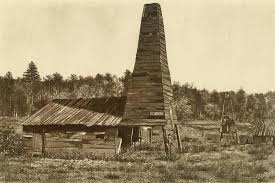
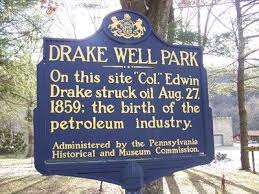
In 1858 a man named “Colonel Drake” was sent from Connecticut to Pennsylvania to begin to drill for the sticky substance. The “Colonel” part of Edwin Drake’s name was meaningless, as his financiers merely invented the title to make him sound more plausible. Most of the residents simply laughed at the man and called the whole venture, “Drake’s Folly” or when leveled personally at him, “Crazy Drake.” However, on August 27, 1859, Edwin Drake would strike oil near Titusville, PA.
The borehole was a mere 69 feet deep, and this first well would produce 20 barrels of crude a day. It was great timing because Drake was now operating on borrowed money and time.
A mad rush was set off, not unlike the gold rush. Towns were springing up in the area, along with the railroad for transport. Some small farm owners were now making up to $9,000.00 a day leasing their land for oil exploration. That’s comparable to $130,000 today.
Hamilton McClintock himself drilled a well in 1861 named McClintock Well # 1. To this day that well still produces oil and is the longest running, oil producing well on record at over 150 years. Today the well is part of the Pennsylvania Historical Museum Commission, acquired in the year 2000. The well, just two miles north of Oil City, PA is pumped quarterly and the proceeds from the oil sales are restricted to repairs and upkeep.
Steam engines were everywhere in the once quiet rural PA mountains. People were showing up by the thousands looking for their fortunes. How important was all of this to America? Pennsylvania was at that time providing one half of the world’s production of oil and not until 1901 when East Texas discovered their oil did it change.
What was it used for?
America was using coal oil for light. The demand for what was then known as “rock oil” skyrocketed when scientist discovered that oil could also be distilled to manufacture and create kerosene. In the early days of America, when the sun went down there was candlelight. To make the day longer, huge industries were born including whaling for whale oil, attempting to find some form of oil to burn for lighting up the darkness.
Machines needed oil for lubrication and so did people. Medicines were created when a man named Samuel Kier first discovered distilled oil helped his wife with her tuberculosis. He called it: “Kier’s Petroleum,” and it would sell for 50 cents a pint bottle.
Then there was this annoying waxy substance that clogged the wellheads. A man named Robert Chesebrough patented a method of creating a balm out of this byproduct substance and called it, “petroleum jelly.” Today we know this balm as Vaseline petroleum jelly.
Drake’s life
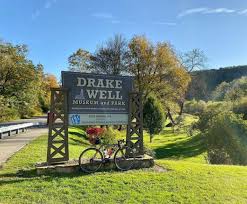
Even though Edwin Drake was tremendously used and is known today as the father of the petroleum industry, he became a pauper and died in Bethlehem, PA, November 9, 1880. Statues have been erected to commemorate this man and what he brought to America. Today this geographical area is dedicated inside state owned grounds called Oil Creek State Park.
The product that Drake brought up from underneath the earth’s surface has literally changed the face of the world in its development of illumination, power and transportation, not to mention industry. Today there are over four million oil and natural gas wells in the US. The recent discovery of deep wells, known as Marcellus Shale, has provided new and far more plentiful sources of gas and oil. Some believe this natural gas find to possibly be the largest in the world.
The next time you find a gooey, sticky substance sticking to your boots, do not believe that ground to be worthless or good for nothing. You just might want to purchase it and become an oil tycoon! (See Numbers 13: 26 – 32.)
 Steve Prokopchak