

As a child, walking around an old “five and dime” store, I watched a gentleman remove the price tag from one sweatshirt and place it on another for a lessor price at the cash register. That occurred almost 60 years ago, but I remember the incident like it happened today. It made such an impact on my young mind.
Integrity is a strict adherence to morality and ethnical value. It is walking in healing and wholeness. Integrity by definition is being “honest” and walking in, “soundness of moral character.” If we lack wholeness in an area of our lives, we can certainly lack integrity within that area as well.
Is integrity perfect?
Can we maintain integrity even while we are on a mistake-filled journey here on earth? I believe we can, as godly character is grown over time and mistakes are a part of that growth. If we live under strict codes, then all failures are placed upon our permanent record. But in living under grace, we find forgiveness for our failures and an Advocate who comes alongside us to reinforce the right responses for future application and personal growth. The journey, while not an excuse for sin, is about growth in the process, not perfection.
I was driving over Memorial Day weekend and within several hours I counted no less than one dozen police officers sitting along the highway in their patrol vehicles. It was a constant reminder to obey the law, or I would suffer the consequences. If I disobeyed, fear would be my response. If I obeyed the law, assurance of no wrongdoing was my confidence. That’s how the law operates. The law is written down or expressed by the lawgiver with certain consequences expressed for breaking that law. Infractions are taken seriously and often our motivation for following the law is fear. However, I don’t believe fear will ever stop us from breaking the law or the rules.
For example, when smoking cigarettes there is a natural, physiological law that is put into effect in which one could eventually suffer from cancer. It’s even written on the cigarette pack themselves, but that law of possibly dying from cancer does not keep most people from smoking. Romans 4 tells us that the law points out the sin when it says, “Where there is no law there is no transgression.”
God’s grace in the process does not operate that way, because perfect love casts out fear. “There is no fear in love. But perfect love drives out fear, because fear has to do with punishment. The one who fears is not made perfect in love (I John 4:18).” Romans 10:4 reveals that Christ is the end or the culmination of the law. God’s grace is not law-filled; it’s love-filled!
Love accepts that integrity is not perfect. Love embraces the journey. Love forgives the wrongdoing and love promotes more love, not fear. Obviously, we’re continually in need of a repentant heart in the growth process. There are plenty of faults to find in the psalmist David’s life, but in Psalm 41 he wrote, “In my integrity you uphold me and set me in your presence forever.”
Integrity avoids moral failure

Life can be full of regrets, but integrity and high moral character will never leave one feeling remorseful. Job’s wife once said to him, “Are you still holding on to your integrity? Curse God and die!” However, the Bible reveals that even after all of Job’s loss, he did not sin or charge God with wrongdoing. What amazing character this man walked in. If you’re like me, you are tempted but if you long to be more like Jesus, you also realize perfection will never be reached. Lifelong integrity can be your testimony and that testimony begins today.
The following examples are numerous areas of life which you would benefit from as you walk in integrity (26 observations). These are expressions of honor toward God and possible personal life consequences if we fail to walk in integrity.
When walking in integrity you would:
- Maintain your personal testimony and walk before God
- Maintain an uninhibited marriage of oneness (spiritually, sexually, emotionally) Obviously, the lack of integrity can greatly affect a marriage!
- Not have to work at winning a spouse’s trust back
- Maintain family by not embarrassing them and not losing their respect and trust
- Depending on your level of leadership, not have to walk away from a job or ministry position
- Not have to relocate
- Not have to face news articles, publicly printed communication and social media posts about personal failure
- Not have to face rumors, gossip and lies
- Not have to face untold and far-reaching negative consequences either based on truth and fact or hearsay and lies
- Not have to face the law or possible lawsuits
- Not lose or forfeit many friendships and local church relationships
- Live without wounds and scars
- Not feel as though everyone is watching
- Not suffer from overwhelming thoughts of failure
- Not continually relive the past, coming up with regret and loss
- Live without continual condemnation and guilt or false guilt
- Be able to sleep at night
- Wake up in the morning looking forward to a new day, rather than dreading a new day
- Not have to be concerned about who you may face in the day
- Not suffer the loss of vision
- Not have to go through biblical discipline and a restoration process
- Be able to look at your family and all others in the eye
- Be able to look at yourself in the mirror without feeling like a failure
- Have a clear conscience; walking through life without a cloud over oneself
- Not lose your peace and joy
- Not suffer the loss and grief of broken relationship with God
That said, integrity goes beyond sexual morality
Integrity does not just touch moral areas of character, but also our character when it comes to finances and truth telling. Jesus talked a lot about money and how we walk out financial integrity, speaking loudly about our character. Our use of money, debt, credit, tithe and giving reveal who owns our finances. When we walk in financial integrity, we will demonstrate a deeper sense of integrity to ourselves and others.
Integrity is full of truth
Truth-telling is a matter of integrity as well. Are we 100% truthful and if not, do we correct our near truths? Proverbs remind us, “The Lord detests lying lips, but He delights in men who are truthful (Proverbs 12:22).” I long to be a delight to my Lord and truthful lips will be a part of that relationship.

It’s up to us. We can choose integrity in some things or all things.
Ten observations about pursuing integrity
- Integrity is God’s choice for me. (I Kings 9:4)
God told David to walk before him with integrity of heart and uprightness.
2. Job said he would not deny his integrity and his conscience would not reproach him.
David wrote, “Vindicate me, Lord, according to my righteousness, according to my integrity.”
3. Integrity starts in my heart. (I Chronicles 29:17)
God tests our heart and is pleased when He finds integrity.
4. It is easier to not be a man or woman of integrity. (Job 2:9)
Job’s wife asked Job if he was going to hold on to integrity, curse God and die.
5. Integrity is something I grow in. (Psalm 103:8 – 14)
God will remove our transgressions, have compassion, realizing we are but dust.
6. Be an example; show integrity.
Do not think of yourself more highly than you ought; use sober judgement. (Romans 12:3)
7. It means not being able to defend ourselves before others at times. (Psalm 25:21; 41:12)
Our integrity protects us. Because of integrity God upholds us.
8. Jesus maintained integrity before men who constantly judged him. (Mark 12:13, 14; Hebrews 5:8, 9; Proverbs 29:10)
Even the Pharisees told Jesus they knew He was a man of integrity.
9. The closer I come to Jesus, the more integral I become. (Proverbs 2:21; 11:3)
When we walk in integrity, we walk securely; integrity will guide us.
10. Proverbs 13:6 tell us, “Righteousness guards the person of integrity.”
The man of integrity walks securely, but he who takes crooked paths will be found out. (Proverbs 10:9 NLT)
If we choose to not walk in integrity, we will eventually need intervention. Intervention will then bring about the need for restoration.
The two sides of integrity
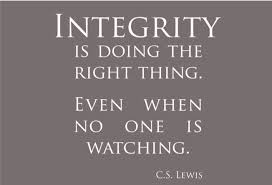
Integrity has two sides: that which you will not do and that which you will do. The latter is often forgotten when it comes to integrity. Integrity is adhering to principles that you or your ethical and moral side hold as truth and of value to follow.
All too often we know what we’re not desiring to do, e.g., be unfaithful to our marriage, cheat our employer, lie on our taxes, or pursue dishonest gains. Even our faith can dictate what we will not participate in. But what about the part of integrity that calls for what we will do?
Romans chapter twelve gives insight into this issue when it says, “Hate what is evil; cling to what is good.” (Verse 9) Do you see the two sides? What are you “clinging” to? In other words, if gossip is wrong and not integral, then what should we cling to? We could begin with telling the truth and then we can add what we really like about a certain person–an encouragement.
If we are tempted to call a politician a derogatory name and slander them, we could refuse to enter into that side of politics and speak life-giving words instead. The scripture is very clear about this area of integrity. To participate in words of slander is clearly not biblical or integral, “But now you must rid yourselves of all such things as these: anger, rage, malice, slander and filthy language from your lips (Colossians 3:8).” (See also Ephesians 4:31; Titus 3:1-5; I Peter 2:1; Jude 1:9,10.)
If stealing is wrong, not integral, we can work hard, earn extra and give more away to others. (See Ephesians 4:28.) Integrity is not just connected to what we don’t do, it is also connected to what we will do and how we will act toward others.
Practical steps
The medical field can be filled with mistakes because humans make mistakes. But I have watched how the medical field polices itself. Self-reporting is required. If my wife, as a nurse, makes a medication mistake, she has an immediate process to follow, to chart and to make others aware. It is an integral process of self-reporting.
If she chooses to tell no one, not chart her mistake, but it is eventually discovered and the error is exposed, she will face immediate disciplinarian action. If she self-reports, the consequences are far less severe.
Churches and church leaders do not often self-report because of the fear of being fired. There are cases of leaders just confessing temptation and/or sin facing no correction or accountability.
Steps we can take:
- Become a self-reporter.
- Assume what you say and do in private will be made public.
- Do not say something, post something or forward something on social media that you would not say publicly to the audience you lead.
- Stay humble, stay real, be accountable, and work on any area(s) in which you may lack integrity. The scripture states to have an honest estimation of yourself.
- Be honest and be trustworthy. Your follow-through is part of your word. Your word and your walk are your integrity in action.
Two warnings: 1. Be forewarned; the lack of integrity has a way of surfacing. 2. It takes a lifetime of building integrity and only minutes to lose it! If you really want to know the integrity of an individual, talk with their spouse.
Embrace integrity today; it’s the only life-building, life-giving way to live on this earth. Ask God to show you any area of your life that lacks integrity. He will show you and He will also make a way of escape in order to change and grow in that area of your life.
Lastly, never assume the “anointed” are full of integrity. Remember that anointing is not necessarily full of integrity or character. Anointing and giftedness may not be removed even as we fail to live in integrity.
In Jim Baker’s book, I Was Wrong, his confession of error was that he placed people on a platform because of their gift and their anointing, even though he knew their integrity was lacking.
“Help us, Lord, to not make the same mistake.”
 Steve Prokopchak