Challenge, Encouragement, Identity, Issues of the Day, Leadership, Prayer

Does Your Serving Jesus Get in the Way of Your Knowing Him?

After a week of rest at a retreat center, I found myself hearing and thinking lots of different thoughts. I have been winding down my full-time work with DOVE International and was taking the time to ask God what’s next. The following are some of my interactions with Him.

Doing has always been important to me. I love work and I, for one, am grateful that God gave us the gift of work. I love labor and the results thereof. I love ministry and its results. I love fulfilling God’s call on my life. But sometimes, I am His “helper.” This week He revealed He already has a Helper, Holy Spirit. 

I can be driven, especially with labor. My wife tells me all the time, “Steve, stop, you’ve done enough for today.” And I just want to finish one more thing. Am I driven or am I drawn when it comes to my relationship with my heavenly Father?

Sometimes I need to remind myself that Jesus had 12 disciples and then He had 11. In Mark chapter six, Jesus sent His disciples out to do ministry, to preach the kingdom. Upon their return His counsel was, “Come with me by yourselves to a quiet place and get some rest.” He must have seen the weariness in their eyes.

Matthew 13:1 records a habit that I believe Jesus walked in, “That same day Jesus went out of the house and sat by the lake.” Jesus, the Son of God, took time with His Father and sat by a body of water to refresh Himself, His spirit, His soul. I asked myself this week what refreshes me, what rejuvenates me?

You and I need a constant sabbath. God rested from creation as an example to us. We are each capable of a lot, but are we called to always say “yes?” I heard someone say this week, “Sometimes the word ‘no’ is a complete sentence.” My Lord was always active in doing the Father’s will, but He never seemed to be in a hurry. He labored out of rest. 

Are you tired? Worn out? Burned out on religion? Come to me. Get away with me and you’ll recover your life. I’ll show you how to take a real rest. Walk with me and work with me–watch how I do it. Learn the unforced rhythms of grace. I won’t lay anything heavy or ill-fitting on you. Keep company with me and you’ll learn to live freely and lightly. 

(Matthew 11:28-30 The Message version)

Standard
Challenge, Healing, Identity, Issues of the Day, Men, Pornography, Singles, Women

Healing for Sexual Addictions

One thing we know from God, the Creator of sexuality, is that His love is completely satisfying. One thing we know from the evil one is that lust is insatiable and can never be satisfied. Pornography and lust are a drive to serve oneself rather than one’s life mate or others.

Viewing pornography may start through curiosity, attempts to fill a void, the need to heal or cover up a deep wound, or just a desire to escape. But escapes have a way of becoming addictions. These could include food, alcohol, TV, novels, caffeine, or many other categories of addictive behavior. Addictions have a way of pulling us away from God, the One who provides a true way of escape. 2 Timothy 2:26 says, “And that they will come to their senses and escape from the trap of the devil, who has taken them captive to do his will.”

The New Testament Writers Acknowledge Our Struggle

Our human struggle with sexual intimacy and sin is acknowledged in Scripture. I love these verses that Paul writes under the inspiration of the Holy Spirit: “But since there is so much immortality, each man should have his own wife, and each woman her own husband. The husband should fulfill his marital duty to his wife, and likewise the wife to her husband. The wife’s body does not belong to her alone but also to her husband. In the same way, the husband’s body does not belong to him alone but also to his wife. Do not deprive each another except by mutual consent and for a time, so that you may devote yourselves to prayer. Then come together again so that Satan will not tempt you because of your lack of self-control” (1 Corinthians 7:2–5).

Viewing porn as a “pastime” is extremely harmful and creates a way for the sexual exploitation of innocent victims. We all need to educate and raise awareness of these dangers in our families, communities, schools, and congregations.

Licentiousness (“debauchery” in the NIV) – This means “excessive indulgence in sensual pleasures, lacking virtue.” Sexual acts on display in pornographic material are acts of fornication because they involve sexual contact outside of marriage. To take part is to condone these acts and involve ourselves in the sin of licentiousness. (See 2 Corinthians 12:21.)

Lust – Pornographic materials are meant to generate sexual arousal in our flesh through lust. Lust, according to the Scripture, is sin. It is corruption of our spirit, our mind, and our flesh. (See Matthew 5:28 and James 1:14-15.)

Sensuality – According to Scripture, observing nakedness is a sinful behavior. For example, in Genesis 9:21–22, Noah’s son, Ham, was cursed because he observed his father’s nakedness, but his brothers Shem and Japheth covered their father with their faces turned the other way. 1 Corinthians 6:12–18 – The body is not for sexual immorality; we are told to flee from sexual immorality. Galatians 5:19 – The deeds of the flesh are immorality, impurity, and sensuality.

The Path to Freedom

A friend of mine told me, “When I was participating in porn, I genuinely loved God, but I also loved porn–at my soul level. At the same time, I also hated it because it brought shame, bondage, ongoing guilt and I wanted to be free. There is a false fulfillment with porn that connects with who I am. Growing up in a pretty strict home with a religion connected to performance, I felt that I could never please God. I just wasn’t good enough. However, when my heavenly Father brought to me the revelation of Ephesians 1: 4-6, I suddenly realized I was chosen, I was adopted, I was loved, and I was accepted as God’s son.” 

Despite so many challenges, certain foundational principles and action steps can lead you to the way of escape that God provides.

  1. God is love (1 John 4:8). If you know nothing else, know God’s love for you. It is inescapable, incomprehensible, determined, and relentless. He loves you and Jesus died for this sin on the cross. He does not reject you.
  2. We all struggle to maintain a clean heart. Many really good people also struggle with sin, even the sin of pornography. You are not alone. Whatever the effects of sin may be, grace is available in abundance to bring healing and freedom.
  3. Recognize that pornography affects the whole individual. God desires to cleanse and heal not only your mind, but longs to set you free from lust, fear, anxiety, wounds, frustration, emptiness, and shame. He died, naked and exposed, for sexual shame on the cross and says to us, “Shame off of you through my sacrifice.”
  4. Disclose and confess your sin to God, yourself, and others. Start being brutally truthful about yourself and your sin. Acknowledge that you have been walking in denial. Uncover the lies. Take full responsibility and recognize the gravity of your situation. Be ruthlessly truthful with yourself, your spouse, and your counselor. Receive God’s forgiveness, because He is faithful and just to forgive us of our sin (1 John 1:9).
  5. Embrace conviction of heart coming from the Holy Spirit and deeply repent. Allow God to bring you to a place of true repentance. Ask yourself, “Who is this hurting?” “What is this costing me in my relationships, finance, time, self-deprivation, and life goals?” Do a personal damage assessment. Ask God’s forgiveness and request His help to forgive yourself.
  6. Be aware of the neurological aspect of this addiction and the brain chemicals involved. Pornography addiction is not just a moral problem. You have created paths for your brain to need and desire the chemical charge provided by porn. These paths that have been flooded with imagery of what is false will need to be starved to death. This is not about reading your Bible more or praying more; a transformation is needed. It starts when you identify what triggers you to use porn. As you identify these triggers, you can ask God why they are triggers, what healing is needed, and how to locate that healing. This requires intense self-examination (confronting your habits) as you scrutinize how your thoughts and feelings have shaped your beliefs. God can reveal whether or not those beliefs are true or are based on lies. Ask your heavenly Father for truth to replace the lies (Romans 8:5-9; 12:1-2).
  7. Locate any deep wounds from your past to discover how those wounds have affected you. If you are unable to deal with your past, you will just be treating symptoms over and over. For example, you could ask: “Is there a shame-filled sexual wound? Did I experience abuse of some kind, then retreat and find comfort in pornography or masturbation?” In seeking these answers, invite and expect Holy Spirit to be your companion and guide.
  8. Discover relational healing by purposefully mending broken relationships. Find new relationships that will help you heal. These could be support groups, a personal counselor, or close accountability with a trusted friend. Monitoring software can be useful, but will not replace real-time accountability to those who love you and care for you. You need a community around you.
  9. Utilize appropriate resources. Find what fits you in terms of books, videos, or other resources. A video series like the Conquer Series, groups like Pure Desire and websites like Faithfulandtrue.com or Be Broken Ministries can be extremely helpful. Fortunately, today there are quite a number of resources and websites available to help those who desire to overcome the power of pornography in their lives. Search on the internet for Christ-centered materials and computer prevention programs like Covenant Eyes and X3Watch to place on your devices.
  10. Go through deliverance ministry. Your mind needs renewal. Deliverance can be helpful to cleanse out the demonically oriented material that has entered your soul and spirit. Openness to evil creates a pathway for more evil. Total freedom can be found in deliverance.

Tying It All Together with the Story of Joseph

There is a wonderful story in the Bible of holy resistance followed by incarceration, but then redemption and hope for a family and a nation. That story is the story of Joseph.

In Genesis Chapter 39, we read the account of Joseph, who was serving in Potiphar’s house. The Bible says God blessed him and he prospered in his Egyptian master’s home. God gave him success in everything he did. In time, the blessing that followed Joseph also affected Potiphar’s household, and Joseph was placed in charge of everything Potiphar owned.

Joseph was described as “well-built and handsome,” and he made a noticeable impression on Potiphar’s wife. She repeatedly attempted to allure Joseph by saying, “Come to bed with me!” Joseph stood firm and refused. Joseph’s words were, “How then could I do such a wicked thing and sin against God?”

Joseph’s response cost him his job and his freedom because Potiphar’s wife lied about Joseph attempting to “make sport of me,” or, as we might say, “rape me.” Even so, Joseph refused to compromise his integrity.

Joseph did not fail his test. Had he given in to temptation, it could have caused the death of millions by famine. He would have never been reunited with his family and he would not have had the opportunity to interpret Pharaoh’s dreams. The favor of God rested on Joseph because he stood firm. Otherwise, he would have been just one more leadership casualty.

The point is clear. You and I have a destiny given to us by God. Your freedom from the sin of pornography is not just about you, but the hundreds that you touch. Your life-long call is tied in to others with the life call of Jesus. When many of those around grow sick of their life of sin, you will have the answer for them, as well as a life that exemplifies that answer. Be a hero like Joseph and confess his words with me: “How then could I do such a wicked thing and sin against my God?”

“The righteous cry out, and the Lord hears them; he delivers them from all their troubles. The Lord is close to the brokenhearted and saves those who are crushed in spirit. The righteous person may have many troubles, but the Lord delivers him from them all” (Psalm 34:17–19).

God is our deliverer. He delivered Joseph. He can deliver us.

Standard
Challenge, Encouragement, Identity, Insecurity, Issues of the Day

Fear vs. Faith

Fear will steal from you;

   Faith will bring increase and enlarge you.

Fear pushes for a retreat;

   Faith pushes for an advance.

Fear brings doubt;

   Faith brings answers.

Fear will keep us from finding our identity;

   Faith moves us toward our identity.

Fear causes us to forget God’s promises;

   Faith causes us to remember God’s promises and then act on them.

Fear delays;

   Faith is now.

Fear brings defeat;

   Faith brings hope.

Fear holds us back;

   Faith moves us ahead.

Fear questions;

   Faith confirms.

Fear brings loss;

   Faith brings gain.

Fear hesitates and vacillates;

   Faith moves us to victory.

I prayed to the Lord, and he answered me. He freed me from all my fears. (Psalm 34:4)

Conquer your fears with a spirit of faith!

Standard
Challenge, Children, Encouragement, Identity, Marriage, Parents

The Primary Role of Parents

Parents do a lot of things day in and day out and are some of the busiest persons on the face of the earth. Few envy the parent of a toddler or the parent of a wayward teen. Parents give more than most humans in any relationship; it’s how we’re built. 

Could we establish one thing from the onset and a truth that bears repeating to others? God gave children to parents. He did not ask school teachers, counselors, the local church or government to parent those we give birth to. That role was given to two select persons, a mother and a father.

As mothers and fathers, we’re teachers, therapists, nurses, singers, coaches, and disciplinarians. It is a never-ending and grueling job that calls for faith, patience, energy and lots and lots of unconditional love. 

But what is the primary role of a parent? Of the necessary and endless things we teach our children and the thousands of dollars we spend to feed, cloth, educate and care for our kids, what is priority number one? 

My wife and I spent 25 years raising children and we loved it. We embraced each and every year. We determined that there were no “terrible twos” or necessary rebellious teenage years. It was our goal to raise happy, healthy, obedient kids who knew Whose they were and who they were. Everything we did with and for our children we did intentionally with God’s direction and help.

Discovering the number one area came to me after a major mistake I made in my parenting. My son wanted to watch a certain TV show that we felt was dishonoring of family, especially fathers. We told him that we would not participate in that program and why. He then told us when he would leave our home he would watch it and furthermore, he couldn’t wait to leave!

Now I knew why I wanted to leave my parents, but why on earth would he want to leave his? He had his own room. We loved him. We loved God. We loved each other. For heaven’s sake, we bought him Nike sneakers and Levi jeans!

God whispered in my ear, “I gave him to you to leave you one day. It’s not a matter of will he leave, but HOW he will leave. And, by the way, I didn’t give him to you so that you could build you in him. I gave him to you so that you could build Me in him.”

I thought I was a pretty good guy. Why wouldn’t my son want to be like me? 

Herein is the primary role when parenting your children, “He is the one we proclaim, admonishing and teaching everyone with all wisdom, so that we may present everyone (our children) fully mature in Christ.” (Colossians 1:28) 

Stop building yourself in your child and start building Christ. It is our primary role as a parent. Your child can do all things through Christ, but our parenting has its limits.

Standard
Challenge, Encouragement, Identity, Insecurity, Issues of the Day

You are Uniquely You

A Thirty Day Devotional adapted from the NEW book: Identity: The Distinctiveness of You – Day 24

I have been blessed with every spiritual blessing. Ephesians 1:3

I am the temple of the Holy Spirit. I Corinthians 6:19

Every decision we make is made through our past experiences, our present desires and thoughts or our future wants or needs.  God has created us with the capacity to think within all three of these realms or dimensions.  The memory capacity of our brains is simply amazing, as it provides for us the knowledge needed from past experience for decision making today.

Just imagine if we lacked memory.  We would not know how to drive home from work today.  We would not know or be able to identify our spouse in the morning when we wake up.  We would have to start each new day reading a memory log from the day before: who we are, where we live, where we work or go to school.  Life would function so differently.  We can conclude memory is not only necessary for life, it provides so much wonderful meaning to life.

The Bible says what we sow, we reap (See Galatians 6:7, 8.).  What I sow today, determines the return I will have on that seed tomorrow.  If I desire a certain crop in the future, then I have to sow that seed today.  Not one farmer expects to reap where they have not sown, but every farmer fully expects to reap where they have sown.  You may expect to be a millionaire one day in the future, but if you do nothing and place no effort toward that goal today, you will never see it.  It is easy to then become deceived into thinking you’ll win the lottery or inherit that million, but without earning it.  The scriptures describe this type of gain as ill-gotten treasure.  (Proverbs 10: 2)

Do you want to live in health in your latter years?  Take measures today to exercise and eat healthy because when reaching tomorrow, today will be the past.  Do you desire to be free of pain from your past?  Then do something about it today and forgive those who have hurt you and bless those who have cursed you.  

Unfortunately, I experienced a lot of cavities as a child.  My family did not use toothpaste with fluoride in it.  Fluoride wasn’t even marketed in those days.  My trips to the dentist were fear-filled and excruciating.  Today, I pay the price of dealing with crowns to save my teeth.  My past dental care affects my present oral condition and will continue to affect my future.  

You just cannot separate these three: the past, the present and the future.  But you can start making decisions in alignment with God’s word and His direction for your life.  A better decision today means a better outcome tomorrow.  A destructive decision today means certain pain in our future.

For example, are you a worrier?  I mean, does your mind immediately go to the exercise of worry when an unknown is surfacing?  Or, is your response to a present worrisome issue one of going to your heavenly Father in prayer and trust?  One response is trusting and relying upon yourself and your capacity to worry (needing to solve the issue yourself) and the other is trusting God and His capacity to intervene both in the here-and-now and the future.  Philippians 4: 6,7 reminds us to not be anxious and if we’ll petition God along with giving thanks, the peace of God will guard our hearts and minds.  Peace does not follow worry; it follows prayer and trusting God, literally giving our worry to God.  (See Psalm 37: 1-8.)

Question for reflection:

If you find yourself to be a worrier, how does your worry affect your present-day life?

Order your book today here.

Standard
Challenge, Encouragement, Healing, Identity, In the news, Issues of the Day, Leadership, Parents

Wasting Your Life Blaming Others

I can’t begin to tell you how many people who entered my counseling office over numerous years attributed all of their life issues to another person or persons. It can always be someone else’s fault. Why? We are very good at finding others to blame.

We can blame:

  • Our parents
  • Our spouse
  • Our ex-spouse
  • Our boss
  • Our coworkers

The list could go on and on. But here is a word of counsel that you can take to the bank:

As long as we feel we can blame another for our problems, we will never know wholeness for that area of our lives.

Said another way:

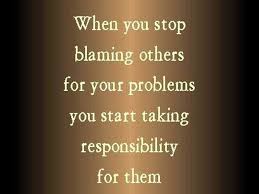
When you stop blaming others, you will then begin your journey to wellness.

When we constantly and consistently blame others for our life problems, we will breed entitlement in our life. Entitlement is an immature “others owe me” mentality. And, they owe me because of what they did to me. Entitlement will breed victimhood. 

Victims do not have to change because…well, they’re victims. Victims remain victims because our culture embraces victimhood as an excuse to live with a life controlling problem. Victims will have a distorted view of reality because they suffered and need others to understand that things happened “to” them. Victimhood will breed unforgiveness. 

Unforgiveness will support us in maintaining a depressed and unthankful heart. It keeps us in the unhealthy state of “That person does not deserve my forgiveness of them.” Unforgiving people are unhappy, unthankful and unhealthy persons.

Maybe your parent was abusive and it started a vicious cycle of hurt and pain. In that case, you are an innocent victim of your parent’s abuse. You may have the option of spending your life blaming your parent(s) and I guess you’d have every right to do so, but staying in blame and not pursuing personal healing only hurts you, not them. 

Jesus was a victim of unjust persecution, as were many in the scriptures.

Jesus knew that ultimately there was a purpose in His suffering and nothing would deter Him from His goal of salvation for all. Even when suffering, Jesus did not adopt a victim mentality. 

Blaming others and walking in longterm victimhood will never allow us to see our own failures, our personal shortcomings. We’ll see the splinter in others’ eyes, but not the log in our own. It will rob us of the initiative to change.

Blaming others and becoming a victim destroys the relationships around us. You cannot dialogue with or challenge someone who is always innocent and right. They simply will not take responsibility for their wrongdoings and wrong words. By the way, this is also why “identity politics” fails so miserably. It constantly creates victims (good people) and oppressors (bad people). There is no healing in this victim-filled mentality.

To heal means you must stop blaming others for your ills and to stop expecting others to fix you or make life right for you.

We need to own our reactions to our hurts and what we tell ourselves about them. To rise above blaming others is to take on the attitude of Christ and His sufferings. Listen to what Peter wrote about suffering.

Do not repay evil with evil, or insult with insult, but with blessing, because to this you were called…But even if you should suffer for what is right, you are blessed. Do not fear what they fear; do not be frightened…[that] those who speak maliciously against your good behavior in Christ may be ashamed of their slander. (I Peter 3: 9,14,16)

So then, those who suffer according to God’s will should commit themselves to their faithful Creator and continue to do good. (I Peter 4:19)

God knows what you suffered at the hands of another. He suffered with you. When we turn our victim status over to Him and receive His healing, we will become victors.

Standard
Challenge, Encouragement, Healing, Identity, Issues of the Day, Pornography, Training

Understanding and Breaking Bad Habits

Most smokers desire not to smoke and most persons know that overeating is harming their bodies. But unhealthy habits are especially hard to stop. Why?

We all have habits, good and not so good. Taking a shower and shaving along with brushing our teeth are all healthy habits. Habits begin with routines done over and over. When we develop a routine, the brain becomes conditioned so that our actions become automatic. In other words, our brains work far less hard when a routine is established. 

Establishing good and bad habits really follow the same course. The major difference is when certain habits are pleasure-based. Enjoyable and repeated behaviors cause dopamine to be released by the brain. This feel-good chemical, dopamine, creates the craving to repeat the action. 

When we’re attempting to quit a habit, we are attempting to force our hardwired brains to do something that it’s been trained to do otherwise. Then, when you add the pleasure-giving dopamine chemical to the equation, the battle becomes even more difficult. 

Further, adding triggers to the routine cause more habit breaking problems as well. What do I mean by triggers? For example, when feeling nervous or anxious some people bite their nails. The anxiety one feels triggers the reaction of nail biting. 

When a habit like viewing pornography begins, there are often triggers from feeling rejection created, but then there is the added feel-good reward of a dopamine wash as one viewes the images. So, certain routines cause certain triggers which can cause certain rewards.

Breaking Unwanted Habits

First and foremost, know and understand why you want to break a habit. The why is important because it could be coming from conviction, from a guilty conscience, or from fear of getting caught. Second, what is the benefit of breaking the unwanted behavior? These steps are a part of deciding that this specific habit is not a good one and your personal conviction is to stop it.

Note: realize there is a difference between sin, breaking God’s commands, and a bad habit. Recognize some bad habits are not sinful. 

Third, ask yourself how you have been justifying this habit. What excuses have you been using to continue it? For example, I can eat several candy bars because I fasted a meal yesterday. Or, I can watch porn because my spouse is rejecting me. Discovering these justifiers will help you to be able to fully admit that this habit is rooted in a negative or harmful thought process.

Fourth, don’t blame others for your negative habits. You must personally take responsibility. If you regularly blame others for your porn addiction, you’ll never quit. If you blame others for your anger, your anger issues will not change. You must take ownership for your habits.

Fifth, stay away from the triggers. Remember, it was stated earlier that certain triggers, especially those which also contain reward, can cause us to act in the routine of certain bad habits. So, if there are specific persons (relationships) or places which help to promote those triggers, work at staying away from them. 

Sometimes when we connect a negative habit with who it affects, it can help us to stop. For example, if our anger has begun to cause our children to become afraid of us (anger causing fear), then we realize change needs to occur so that our children know and respond to our love.  

Sixth, enlist a faithful friend to hold you accountable. Ask someone who will not judge you but rather care enough to lend support toward change. 

Step seven can be to replace the bad habit with a good one. This is an attempt at rewiring the brain away from the unwanted behavior toward the desired behavior. 

Eight, practice self-control. The more you practice self-control, the more you exercise the brain to develop a new habit (like a muscle exercising). Both the new and the old habit are in your brain; practicing the new enlarges the self-control muscle. This is also the principle of sowing and reaping. As you sow the good habit, you will reap the good results. 

Nine, keep enlisting God’s help. Keep depending upon the Holy Spirit to protect you, to provide new ways to respond and to give you new thoughts.

Ten. Lastly, one of the best ways to put to death a negative habit is to reinforce your healing, your change and your renewed mind by helping others in that very same area!

“…Clothe yourselves with the Lord Jesus Christ, and do not think about how to gratify the desires of the flesh.” (Romans 13:14) And, “Whatever you do, work at it with all your heart, as working for the Lord…” (Colossians 3:23) 

Standard
Challenge, Encouragement, Healing, Identity, In the news, Issues of the Day

Prince of Peace

Over 700 years BEFORE Christ’s birth the prophet Isaiah wrote:

For unto us a child is born, to us a son is given, and the government will be on his shoulders.

And he will be called Wonderful Counselor, Mighty God, Everlasting Father, Prince of Peace. (Isaiah 9:6)

Handel’s Messiah included these words and choirs have been singing them since the year 1741.

Our English word, peace, has far more meaning than we realize. In Hebrew, the word is “Shalom.” It is often used by Jews and other nationalities as a word of greeting. Shalom has many beautiful and meaningful definitions. In the Hebrew, it is far more than just peace. It can mean completeness, cessation, repose, safety, soundness, tranquility, prosperity, fullness, harmony, lack of worry, and the absence of anxiety. That takes peace to a whole new level!

This peace from the Christ child has amazing meaning for our lives today. It is:

  1. Restorative – Through His peace we are restored to the Father. “For he himself is our peace…He came and preached peace to you who were far away and peace to those who were near. For through him we both have access to the Father by one Spirit.” (Ephesians 2: 14-18)
  • Harmony – We can have harmony and peace with all of life’s circumstances and disappointments. When we rest in Him, find our completeness and our fullness in Him, we can be at peace no matter the situation. “And the peace of God, which transcends all understanding, will guard your hearts and your minds in Christ Jesus.” (Philippians 4:7)
  • Reigning – Jesus reigns in peace! He rules in our hearts and His peace is eternal. (See Revelation 21:3-4.) “You will keep in perfect peace those whose minds are steadfast, because they trust in you.” (Isaiah 26:3) That word “steadfast” literally means that we can lean into and rest upon His peace!

When someone greets you or signs off a letter with the Hebrew word for peace, shalom, they are repeating what Jesus pronounced while on the earth: 

“Peace I leave with you, My peace I give to you. Let not your heart be troubled, neither let it be afraid.” (John 14:27)

Many things can attempt to steal our peace this Christmas season. There are wars and rumors of wars, broken relationships, diseases, financial worries and more. But the Prince of Peace has come, has returned to the Father and is coming again. He bids you Shalom.

Glory to God in the highest, 

    And on earth peace, goodwill toward men!  (Luke 2:14)

Standard
Challenge, Encouragement, Identity, Insecurity, Issues of the Day

The Power of Fear

I recently posted a quote from my book, Identity: The Distinctiveness of You, onto Facebook that went like this: “Fear can be very real because the consequences are very real.” Not all fear is bad, but not all fear in our lives is filled with truth either. Often a “truth” we carry is not the truth. 

Fear will enable us to carry thoughts, emotions and reactions to beliefs that feel very real, but are based on lies. For example, if we fear snakes, we will be on the lookout for them as we walk a narrow hiking trail in the mountains. When we come across a brown or black crooked object on the ground, we may think, “SNAKE” and run. But when we take a closer look we discover it’s a stick and our heart returns to our chest. Fear is programed in our minds from a past experience in order to keep us safe from the object we fear. 

But the truth is: most snakes are harmless. However, that doesn’t matter when we fear them. We’ll fear all snakes. 

The scriptures remind us that perfect love casts out fear. (I John 4:18, 19) So, the opposite of fear is love. Let’s consider some everyday fears versus the reaction of love.

Fear requires us to perform. When love is present, we desire to do well.

Fear will not maintain a healthy relationship, while love will be what holds a healthy relationship together. 

Fear will impede your responses. Love will bring you the freedom to respond.

Fear will keep you from taking risks or chances. Love allows the freedom to be a risk-taker. 

Fear will hold you back from maturity. Love is an encourager and promotes personal growth.

When in fear, you will hold back. When in love, you will give away more freely. 

Fear will cause you to lack confidence. Love grows confidence.

Fear can be full of self, while love is selfless. 

Yes, fear is real, but love is far more powerful. Ask God for more of His love so that fear is overwhelmed and has to retreat. “For God has not give us a spirit of fear, but of power and of love and of a sound mind.” (II Timothy 1:7)

Standard
Challenge, Children, Identity, Insecurity, Marriage, Men, Parents, Women

Providing Security for Your Children

What is the number one security need of a child? The answer is an intact family. Expressed or not, children whose parents remain together are more secure children. A close-knit family, regardless of personal family income or status, will give their children a sense that all is good in the world. 

As parents express affection in front of the children on a daily basis, it just might cause some initial reactions of “gross,” but on the inside they’ll be smirking with delight. 

Are you holding hands in front of your children, kissing or expressing love to one another? Are you praying together, going out on dates and verbalizing out loud to one another how important you each are? Do your children witness your uncompromising love, commitment and personal connection? Do your children hear you thank and appreciate one another for all you do to make this family work?

These are expressions of security to your children. Incorporate them on a daily basis and watch their reactions. They may tell you to “Go get a room,” but their security meter will be on the rise.

Standard