 Maggie has never had a problem with her self-image. She loves life and makes the best of every minute. She loves people and believes that they all love and accept her unconditionally. Maggie has never stared into a mirror and felt hopeless. She’s never even desired to look at herself in a mirror and make any kind of judgment. She is perfectly content with who she is, what she wears, the shape of her body, the color of her eyes, the size of her nose, and the shape of her ears. Maggie blindly trusts in her Creator. She is content to be who she is. You see, Maggie is our yellow Labrador Retriever.
There is a lesson in Maggie’s self-acceptance. Maggie is loved and accepted for who she is as a part of our family. She doesn’t need to perform for us. Does she always obey and not get into trouble? No. But her disobedience has never changed the fact that we love her, and she knows it. Neither has it changed how she sees herself. Maggie does not compare herself to the other dogs that wander into our yard. She’s never put herself on a diet because of a fear of losing her wonderful figure. She’s not even concerned about belching or the breath that comes from never brushing her teeth. Maggie is secure in just being a dog and knows her significance to our family.
Early in life children are quite similar. They can look in a mirror and see only good. Children believe what they’re told. If I tell my daughter 3 + 3 = 6, she’ll say, “Okay Daddy, 3 + 3 = 6.”
If her older brother tells her the next day that the sum of 4 + 2 = 6, she’ll disagree, because the day before she was told that 3 + 3 = 6. Your pre-school children think in a one-dimensional manner. They do not think abstractly. They cannot decipher truth. They only know what you tell them.
 A child receives his self-image through how he perceives the adults in his life perceiving him. When I tell my daughter that she’s beautiful, she will believe that she is beautiful. You see, someone who is very important to her, someone she can trust, someone who is bigger, older, wiser and stronger told her something about herself, and she has no reason to not believe it.
Obviously, the opposite is true. If I, as a parent, tell my children they’re stupid, dumb, bad, worthless, or they have no value, they’ll believe those things and act accordingly. Today we would call this emotional abuse. Years ago it was simply punishment through shame or keeping children “in their place.”
The first stage of a child discovering his worth is through the eyes of those who are important to him. The second is similar but has more to do with performance.
It is not long until we as parents expect things from our children. We expect them to do their chores, keep their rooms clean, and finish their homework. When they do, we may reward them. When they don’t, we’re sure to let them know about it. Expectations are not wrong; chores are not wrong; rewards are not wrong; and words of correction are not wrong. What is wrong is if you develop within your child this formula: accomplishment + performance = approval/reward.
God has expectations of His children, but it is not our performances or our accomplishments that gain His approval. God is perfect, yet He is not into perfectionism. In our mere existence, He approves of us.
Let me illustrate. When you brought your newborn son or daughter home from the hospital, did you expect anything of him or her? Did you say, “Here’s the refrigerator; when you’re hungry go ahead and grab a bite to eat”? Of course you didn’t. You expected to do everything for this child without return. It was lots of hard work and sleepless nights. In this baby’s mere existence, you approved of him or her. You had no expectation of performance. That baby, without earning it, had your approval. Likewise, in your mere existence before God, you have His approval.
When your child begins to relate his or her performance to your approval, he begins to equate what he does as more important than who he is. Ask anyone who felt that he could not perform well enough to meet his parents’ standard, and he’ll tell you that he did not feel good about himself.
If we as parents are relating self-esteem to what our child accomplishes, we are wrong. God is not a harsh taskmaster who only gives His approval when we accomplish something for Him. Before Jesus began His earthly ministry, before performing one miracle, or sharing His first sermon, His Father said to Him, “…this is my beloved Son, in whom I am well pleased.” What was He pleased with? What had Jesus accomplished? Even before Christ began His public ministry, His Father affirmed Him and spoke His unconditional love and acceptance to Him.
The answer to a child’s self-esteem is not a high-esteem. The answer is a God-esteem. Your love, acceptance, and approval of your child must eventually translate for him into knowing his heavenly Father’s love, acceptance, and approval.
 How is this accomplished? I must correct and reward my children. It’s a part of life. However, I must differentiate that while reward and correction have to do with behavior, it is never a question that I love and accept their personhood. In their mere existence, they are important to me. I always approve of them as individuals. They can never do anything to not be my children. A verse in Colossians, chapter one, will help to explain this principle. Verse 21 tells us that we were at one time alienated from God—even in our minds, because of our evil behavior. “But now He has reconciled you by Christ’s physical body through death to present you holy in His sight, without blemish and free from accusation…”
Can you grasp that you are “holy in His sight, without blemish and free from accusation”? Can you instill these words of truth in your child? This is an esteem not based upon performance or accomplishment but based upon what Christ has done. It’s a God-esteem!
Note: If you would like this article in tract form you can order it here.

 Our family often had the nations around our table as our children grew up. We loved the cultural examples each one brought to us. I remember in particular a couple from Zimbabwe who we invited from a local college for Thanksgiving. In the middle of the meal the wife told us, “You throw away the best parts of the turkey.” We all had a great laugh because we do not eat the head, liver or the feet of a turkey. But we desired our children to know and understand that every life is valuable to God and His design for them. God’s kingdom is a kingdom of nations and nations represent people.
 Proverbs 12 tells us, “The words of the reckless pierce like swords, but the tongue of the wise brings healing.” What does your tongue bring to those around you, your co-workers and your acquaintances? I am personally challenged by my thoughts (not often spoken, but still thought) that do not think the best of others or those thoughts which do not give those different from me the benefit of the doubt. To have the privilege of traveling the world and to experience different cultures is enlightening, while at the same time difficult to not think comparatively, i.e., my culture vs. their culture.
 Politicians can be an especially difficult bunch due to their near truths or outright lies, placating, patronizing, cover-ups, political correctness and bottom line desire of being reelected. You rarely know who is telling the truth today. You especially rarely know the full truth because of a press that now also includes “fake news.” Further, the news outlets often only report what will support their causes and their politicians. It is why I love inside reports from Christian leaders I am acquainted with (throughout the world) who are in the know about so much of what is truthfully happening around the world.

 As Christ followers, we have a long way to go to do more listening, considering, growing and developing. But there are many undeniable written words from God that do not and will not change with culture. We are called to influence culture with Biblical truth. While our opinion may be valuable to some, it will not supernaturally change a life.
 Where did your beliefs come from? Have you ever thought about that question or do you just assume your beliefs are mostly correct? It’s a simple question that takes a fair amount of reflection.
 Dating is not a centuries old concept. Dating is a far more recent notion than that, but unlike what Hollywood presents, dating is NOT about how good someone is in the bedroom. The following are ten distinctive thoughts to consider if you or someone you know is involved in a dating relationship.


 We hear far too many reports about marriages that are not lasting. When marriage is full of selfishness, insecurity and immaturity, marriage becomes an attempt to receive healing from our spouse, i.e., if they’re the problem, they’re the solution as well. When our spouse deals with the same inadequacies, they are unable to give what we’re looking for. Over a period of time, the thought of having married the wrong person is often generated.
 issues in your life. Too often we blame our spouse for our worst and then think they’re the problem, believing the lie that all would be better if they would make all the changes.
 Maybe you already know this, but I’m in my sixties. Seems a bit weird to even write that line, but I love this stage of life; it has a certain…appeal to it. You get to hear the statement, “I already gave you the senior discount.” I also hear this comment all too frequently, “Your wife looks younger than you.” To which I normally reply, “Yes, she does, but she’s actually older than me.”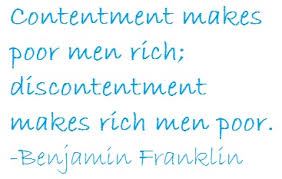
 “Contentment is now, not when.” That is the word of revelation God spoke to me one evening while driving home from my office many years ago. I choose contentment today over discontentment. My Father has given me everything I need and I can trust Him for everything needed in the future. Contentment is the state of my heart.
 Should we wait until our leaders are experiencing physical, emotional and spiritual exhaustion in their lives before we develop a sabbatical policy for our local church or ministry? In a New York Times article titled, “Taking a Break from the Lord’s Work” (Aug. 1, 2010), Paul Vitello wrote, “Members of the clergy now suffer from obesity, hypertension and depression at rates higher than most Americans. In the last decade, their use of antidepressants has risen, while their life expectancy has fallen.”
 Quite a number of years ago I fell in love with a couple of verses found in the Old Testament from the prophet Jeremiah. This man of God heard the Holy Spirit whisper in his ear these words:
 Here’s a really practical, tip-filled article to help you with your next car purchase (pass it along to your friends). In 1996 I helped to start a car business with a friend and I have been purchasing cars for people ever since. I love providing this service and am amazed at what people do not know when it comes to a car purchase. Maybe you have something to add to the list, feel free to comment.



 Steve Prokopchak