
 I am not totally sure why comparison is so often our human go-to mode.
I’m guessing the experts would have a lot to say on the subject, but the Bible has something to say as well. It states, “We do not dare to classify or compare ourselves with some who commend themselves. When they measure themselves by themselves and compare themselves with themselves, they are not wise.” (II Cor. 10:12) Pretty straightforward, eh?
Some years ago I wrote a tract about developing a child’s self-esteem and started out with the story of Maggie. I observed that Maggie never combed her hair, brushed her teeth, looked in a mirror or compared herself with anyone. She was our Labrador Retriever whose full name was Sweet Magnolia of Pheasant Hills, aka Maggie. She knew who she was, who she was created to be and she knew our unconditional love and acceptance of her. Perhaps that’s what’s missing in our lives…knowing who we are, what we’re created for and that we’re all unconditionally loved and approved of by our Father in heaven.
The Bible says that comparison is unwise. Why? When we compare ourselves to someone else we typically come up short or proud, insignificant or feeling better than another. Obviously these outcomes are unproductive and self-deprecating. Comparison is often full of feeling less than, not measuring up or lacking in performance. Or, it’s full of pride, feeling better than and viewing oneself as more significant than others by out performing. Crazy thing is it’s all within our own minds.
If you have children help them to not compare themselves. Children have their own unique gifts and talents. Do not make performance the determining factor of your love, acceptance and approval of them. Never compare them with their sibling. Comparison is full of critical judgment and will eventually kill their creativity.
 Ask God to help you hear your own thoughts of comparison and allow Him to speak truth-filled words over you rather than your own negative or pride-filled mental dialogue. I wrote another prayer tract called, Who I am in Christ and it is filled with the truth of scripture to help you know whose you are and why you exist so that comparison can end once and for all.
 “I grew up in a Hindu family and was introduced to the worship of many gods,” said my new friend. “However, those ‘gods’ as I grew older, became more and more aggressive, unfriendly, demanding and evil.” Her family told her this familiarity was highly favored and to be embraced, but nothing about this world felt favorable to her. At the age of sixteen, someone introduced her to Jesus and she received Him and His love into her heart. She told me there was a profound change in her life and she soon realized that the “gods” she carried with her were actually demonic presences or spirits meant to torment her. She wanted them gone from her life.
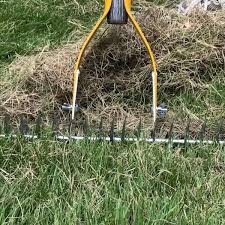 I really enjoy thatching my lawn every spring for several reasons. The most obvious is that a long winter season is coming to an end, the birds are singing and the perennial flowers are breaking through the earth’s surface. Secondly, I love working outside, especially after a cold spell that keeps you held captive to the indoors. Third, it is meaningful that my heavenly Father has provided a place for me to live and enjoy and lastly, most of all, thatching is a reminder of God’s ability to remove the old, unwanted and dead vegetation that is no longer productive.
 What does the resurrection of Jesus Christ, the Son of God, mean to you?
 A number of years ago my wife and I visited some churches in the nation of Rwanda. We were responding to an invitation to share marriage principles with these lovely, but broken people. Just leaving the airport, we were told by our hosts, “But first, you will visit the genocide museum.” Mary and I could hardly speak after seeing those images and reading about what happened in this war-torn nation. We were wrecked from the inside out and, quite honestly, our hearts ached. It was difficult to gather our emotional selves for the service that evening. As we looked into the Rwandan’s eyes that night, we wondered what images they carried with them.
 Our family often had the nations around our table as our children grew up. We loved the cultural examples each one brought to us. I remember in particular a couple from Zimbabwe who we invited from a local college for Thanksgiving. In the middle of the meal the wife told us, “You throw away the best parts of the turkey.” We all had a great laugh because we do not eat the head, liver or the feet of a turkey. But we desired our children to know and understand that every life is valuable to God and His design for them. God’s kingdom is a kingdom of nations and nations represent people.
 Proverbs 12 tells us, “The words of the reckless pierce like swords, but the tongue of the wise brings healing.” What does your tongue bring to those around you, your co-workers and your acquaintances? I am personally challenged by my thoughts (not often spoken, but still thought) that do not think the best of others or those thoughts which do not give those different from me the benefit of the doubt. To have the privilege of traveling the world and to experience different cultures is enlightening, while at the same time difficult to not think comparatively, i.e., my culture vs. their culture.
 Recently while in the nation of New Zealand, a friend pointed to a fellow teacher and said, “See that older gentleman?” I assured him that I did. He went on to explain, “I am younger than him and I am retired from teaching.” I asked why he chooses not to retire figuring the conversation was leading that way. My friend replied, “He tells me he wants to continue teaching because it is far better than going home and living with his critical wife.”



 Politicians can be an especially difficult bunch due to their near truths or outright lies, placating, patronizing, cover-ups, political correctness and bottom line desire of being reelected. You rarely know who is telling the truth today. You especially rarely know the full truth because of a press that now also includes “fake news.” Further, the news outlets often only report what will support their causes and their politicians. It is why I love inside reports from Christian leaders I am acquainted with (throughout the world) who are in the know about so much of what is truthfully happening around the world.
 As Christ followers, we have a long way to go to do more listening, considering, growing and developing. But there are many undeniable written words from God that do not and will not change with culture. We are called to influence culture with Biblical truth. While our opinion may be valuable to some, it will not supernaturally change a life.
 Where did your beliefs come from? Have you ever thought about that question or do you just assume your beliefs are mostly correct? It’s a simple question that takes a fair amount of reflection.
 Steve Prokopchak