Challenge, Children, Encouragement, Marriage, Men, Postmarital, Premarital, Women

The Value of Kissing

Kissing. Who knew its scientific value? Who could imagine that this form of affection actually brought comfort, security, emotional satisfaction and even released feel good endorphins?

In a Psychology Today article from 2023, key lessons were explored when it came to kissing. There were obvious, predictable and emotionally boosting improvements discovered in the relationships that prioritize kissing. 

First, what does a kiss do? It is a sensual connection within marriage that communicates affection and even deepens the relationship. Kissing reduces stress, tension and anxiety. Kissing boosts our immune systems through the trading of saliva. Kissing releases dopamine to improve one’s mood and foster more contentment. It is a non-verbal form of communication that speaks volumes, especially on the romantic side of marriage. 

The article went on to share, “A skilled kisser is more likely to be in sync with their partner’s needs…and it promotes higher levels of relationship satisfaction and sexual satisfaction.” Why? Because kissing is not just a physical connection but it also connects us emotionally. It is being in the moment with your mate. When we kiss, we are continuing to build a healthy relationship, an emotional charge and a physiological enhancement to our marriage. 

These are all psychological benefits that improve our overall marriage satisfaction and should never be underestimated as a powerful tool for keeping the flame burning. Regardless of how long you are married, don’t lose the art, the connection and the value of a kiss.

Kiss when you leave the house.

Kiss when you return.

Kiss when praying together.

Kiss as you retire for the evening.

Kiss in front of the children and kiss for no reason at all.

Standard
Challenge, Issues of the Day, Marriage, Men, Postmarital, Small Groups, Training, Women

A Marriage Mentoring Group is Born

Multiple younger couples were either coming to us or we were having them over to our home for a meal. It seemed apparent they were looking for marriage mentors, a spiritual mom and dad to walk with them and share some helpful marriage principles. 

And so, it began. Ten groups and ten years later we are still excited about marriage mentoring. We grab four couples, hand picking them to invite to our group. They should not be on the verge of divorce or in desperate need of counseling. This is not a counseling group. This is a group that receives care, concern and input, but also gives it to the other couples. It is their group, not ours. My wife and I are the facilitators. 

We use our book Staying Together, Marriage: A Lifelong Affair and go through it chapter by chapter. We begin in February and end the following January on a weekend retreat together. We meet once per month on a Tuesday evening with dinner together; everyone helps with the meal. 

That first hour around the table is full of reporting about the last month, prayer requests, jokes and laughter, fun and fellowship. The following two hours are in our living room sharing our experiences and questions in marriage provoked by the reading assignment. We laugh, we cry and we pray. We talk, we get passionate and we get real about our lives as married couples. 

Mary, my wife says, “This is my very favorite group all month. We love these ‘kids’ and we love their authentic, truth-filled responses.” If you are a happily married, seasoned couple with a heart for marriage, you can duplicate this very group. Young couples are just waiting to be asked. They are a hungry generation looking for help to succeed in their marriages. They long for parents who will encourage them, tell them they’re wrong at times and provide loving examples to them. The book will help you and guide you with plenty of questions, but it will take a back seat to the relationships that are built. 

Do you want the divorce statistics to decrease? Then take my challenge and start your own marriage mentoring group. Meet consistently once a month for one year and you will change lives and build memories for a lifetime. 

Standard
Challenge, Encouragement, Healing, Issues of the Day, Marriage, Men, Postmarital, Women

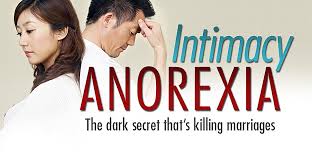
Intimacy Anorexia

It’s not my term. Author and speaker Dr. Doug Weiss coined the term and states it’s why some people “actively withhold emotional, spiritual, and sexual intimacy” from their partner. He writes that some of those issues can be identified as:

  • Keeping themselves busy with child care, household tasks, technology or work. Too busy for you, but not others.
  • Blaming you [or others] for the loss of intimacy rather than exploring potential patterns in their own behavior.
  • Withholding love, especially in the way you desire to receive it.
  • They stop complementing you.
  • Have little to no interest in sex.
  • Show little interest in connecting on a spiritual level.
  • Avoid talking about their feelings and not connecting on an emotional level.
  • Treat you more like a roommate and not a romantic partner.
  • Have money control issues or desire to control the money.
  • Have anger outbursts, ignore you or give you the silent treatment.

Wiess states it doesn’t take all these issues, maybe just five of them to experience sexual anorexia. He believes many persons who survive some form of sexual abuse will respond in this way to their marriage partners. 

Further, these relationships can be full of frequent criticism, including criticism of things one cannot change. 

Persons who exhibit these types of behaviors have more than likely experienced something traumatic in their growing up years. In their adult world, however, they are attempting to avoid the pain of their misguided view by avoiding intimacy. 

Intimacy requires trust in a relationship. It requires vulnerability. It requires safety and, of course, that all important ingredient: love.

Sexual intimacy within the boundary of marriage brings glory to God.

Sexual intimacy within the boundary of marriage draws marriages closer to God and one another.

Sexual intimacy within the boundary of marriage is always centered on your spouse.

Sexual intimacy within the boundary of marriage promotes deeper love, commitment and pleasure.

If you find yourself battling with any of the above descriptions of intimacy anorexia, please see a counselor who is familiar with the subject.  

Standard
Challenge, Encouragement, Healing, Marriage, Men, Postmarital, Women

Marriage Disappointment

Marriage is never 100% awesome and amazing. It’s hard sometimes and sometimes we say the wrong things. Sometimes we think the wrong things or do the wrong things. For everyone who is married, we are all on a learning path, a growing path. If your marriage has become critical or stale, it’s up to you to change that. If your marriage has become a disappointment in some form or fashion, perhaps you’ve veered from the path and have lost your way on the journey. 

The story is told that in his later years the legendary Babe Ruth had became overweight, slower, and struck out far more frequently. The baseball fans began to jeer him.

Apparently, the displeasure of the fans got to a small boy who leaped over the railing and ran onto the field to wrap his arms around the legs of this declining athlete. With tears plentiful in his eyes, the little boy expressed his love for the man that he knew he once was. The Babe picked the little boy up and embraced him as well. Together they walked hand in hand to the dugout. The crowd’s displeasure turned to cheers for the display of unconditional love on the field that day.

Your marital love is like that picture. Our marriage becomes “overweight” or “slower” and we “strike out” sometimes with our words and our actions or lack thereof. We fail each other occasionally. We make errors in the game of marriage and we disappoint one another. 

But regardless of how we may feel, every once in a while we need to wrap our arms around each other and express our undying love and remain faithfully on the journey of growing older together. 

                HAPPY VALENTINE’S DAY!

Standard
Challenge, Encouragement, Healing, Marriage, Men, Postmarital, Premarital, Women

Marriage Issues are “Our” Issues

Someone recently commented to my wife and I, “Wow, it encourages us to know that Steve and Mary had marriages issues too.” They were reading about our marriage in our book, Staying Together. We laughed as we confessed there is no perfect couple or perfect marriage.

In the book, we describe something traumatic that occurred to Mary, my wife. And in the book, we described how it affected our marriage for several years. 

An issue Mary was dealing with became a marriage issue because we are one. What affects Mary affects Steve; what affects Steve affects Mary. 

I could have gone on in life and lived in a manner that blamed her for the issue. I could have told her to get counseling for herself without me by her side. I could have distanced myself from the issues that were causing other issues and simply said, “It’s your problem; get it fixed.”

But is that the right approach in marriage? Is that showing marital commitment? Is that caring for another’s needs? Husbands and wives take this approach everyday saying, “It’s not my problem.” But if we’re married–if we’re one–then it is not his or her problem, it is our problem. When I make it my spouse’s problem, I am saying that I do not need to change, I do not need to support them and I do not need to be concerned. But, when I make it our problem, we are then walking and working together toward solutions and a better and a stronger outcome.

Marriage is a gift of oneness. There are three mentions of oneness in the scriptures: God the Father, Son and Spirit are one. Jesus and His church are one. A husband and a wife are one

As one, individual problems become our problems. So, get in there and fight for and alongside your spouse through each and every life issue. Find solutions together. Walk together and pray together. And to that end, find agreement together over any and all life issues.

Standard
Challenge, Encouragement, Healing, Marriage, Men, Postmarital, Premarital, Women

Conflict in our Marriages: Why We have Them

Conflict is easy; resolve is hard!

Most of us know how to do conflict, argue, disagree and/or fight, but few of us know how to resolve, come into agreement and heal conflict in our marriages. That’s what this blog is about. So, let’s start with a few facts:

  1. Even in conflict we need to maintain a right attitude toward one another. Conflict is not always detrimental in marriage, but it does test our faith, our patience and our personal level of grace. According to the scripture, it also develops character (Romans 5:3-5; James 1: 2-4). In marriage, we are often “using” one another to help smooth out our character. Our conflicts can be (will be?) deeper because our love is deeper.
  1. James said to let perseverance finish its work so we can mature. The natural response to conflict is more conflict, a desire to win or bailing out, quitting. But when we push through, pray through and persevere through the trial the outcome will be perseverance doing its work. The problem is too many couples quit, give up and believe it cannot be resolved or they want others to resolve it for them. The truth is the more we persevere, the more victory we will eventually have. Ask any couple who fought through financial differences, persevered, stuck to a budget until they saw the reward and you will find a couple who is extremely strong in the financial realm.
  2. Whatever we sow, we reap. Sowing and reaping is at work in our marriages. If we sow the negative, we will reap it. Typically, we sow discontentment and criticism because we’re not getting what we want. The seed of criticism cannot produce the fruit we’re looking for. In the midst of disagreement think about what good seeds you can sow.
  3. Don’t give the enemy a foothold by not coming to resolve (Ephesians 4:26-27). A marriage that holds bitterness, sows negative seeds and criticism, etc. is not doing what Peter said when he told us to be considerate of our wives and treat them with respect so our prayers are not hindered. In other words, prayer will be powerless in the home of disrespect, discontentment and the lack of peace.
  4. Be aware of what Paul called selfish ambition (Philippians 2:1-2). Most of our conflict is over selfish preferences rather than desiring the best for one another. 
  5. As conflicts are resolved, God uses those areas in our lives to help others. I know that sounds far off, but it’s true. We will have authority to speak into that which we have had to grow through and have experienced winning the battles. Believe God for win/wins.
  6. Lastly, we are to love deeply. I Peter 4:8 tells us “Above all, love each other deeply, because love covers over a multitude of sins.” Love often means overlooking, forgetting and not pointing out failures. It’s a “keeps no record of wrong” position. 

God wants you to be able to resolve conflict and I believe He gives us the tools to do so. Obviously, we both need to stick to the plan He gives us and press forward believing by faith for His outcome to our marriage as hard as it is at times. Conflicts are not the problem, we all have them, but not resolving them sure is.

Here’s a possible assignment: Write down the common triggers in your relationship that tend to cause conflict and discuss why and how. Ask God to bring healing to those areas in your lives. Remember, your spouse is not your enemy but rather your life mate who loves you and desires the best for you.

The more healed we become individually, the more healing our marriage will experience. 

Standard
Challenge, Encouragement, Issues of the Day, Marriage, Men, Postmarital, Women

Missing Ingredients in Marriage

Can anyone out there identify with the following scenario?

Early on we really enjoyed our sexual intimacy, the frequency, knowing one another’s likes and dislikes, the freedom that comes from being committed to one person and having the bond of marriage between us. But in time, we lost something. The relationship outside the bedroom began to diminish in multiple ways. We lost the intimacy of conversation, prayer and worship together, and taking walks hand in hand. And yet, one of us still wanted the perk of sexual intimacy. I felt used and even became angry. I remember thinking, “You want me for this, but not for much else in life.” Resentment grew and feelings were hurt. 

I want it back. I want to be madly attracted to him again. I need the intimacy of conversation with each other and with God. I need him to hear my heart and touch my heart as I long to touch his. I want him to lead me and our family toward Christ’s mission for us.

What’s the impasse about? Where exactly does the silent frustration stem from? Is it purely a sexual need? 

What we want and desire most in marriage is connectedness, oneness toward our co-mission, and concern for one another’s spiritual care. How do I know this? Paul wrote in Colossians 1:28-29 that his biggest concern for his fellow believers and disciples was, “…to awaken hearts and bring every person into the full understanding of truth. It has become my inspiration and passion in ministry to labor with a tireless intensity, with his power flowing through me, to present to every believer the revelation of being his perfect one in Jesus Christ.” (TPT)

When we prioritize building Christ in our mate, we will connect in all the ways we as human beings, husbands and wives need and desire that connection to take place. From the yard to the bedroom, this connection hinges on our spiritual connections each and every day.

Are you praying and worshipping together? As you do, you will connect spiritually, emotionally, and physically.

Standard
Challenge, Encouragement, History, Marriage, Men, Parents, Postmarital, Women

When Leaders Marriages Go Awry and Steps to Maintaining Health

It is a well-known fact that John Wesley married late when he married Molly. John was 47 and Molly Vazeille, a widow with four children, was 41. Their courtship was 16 days long.

Wesley preached sermons the day before and the day after his marriage. Within a week, on a Sunday morning, Wesley referred to his marriage as a “cross” that he had to reluctantly bear. 

Wesley believed his ministry came first and that Molly would simply have to adjust what she desired for his call to ministry. 

Repeatedly, Molly complained that John was insensitive, always traveling, never home and not paying her any attention. John then tried to take Molly with him. Molly didn’t care for traveling hundreds of miles on horseback in the rain or having threats made on their very lives. 

John attempted to repair things, but in the end gave up as ministry remained first in his life. They never divorced, but remained separated. Molly disrespected her husband for his treatment of her both publicly and in the home. 

Lessons to be learned

As a leader, your marriage comes before your ministry. Scripture is repeatedly clear about this. When qualifications are mentioned for church leaders, it is one’s character and one’s family relationships that are highly considered. (See Titus 1:6-9.)

When a leader fails at leadership in his or her home, it will not be long until their public ministry fails also. 

What to do

  1. Be accountable in your marriage relationship with an overseer.
  2. Seek first His kingdom and care first for your marriage and family.
  3. Pursue counsel when needed so your marriage stays on course for the test of time.
  4. Repent quickly of wrongdoing in your marriage.
  5. Forgive deeply.
  6. Attend marriage seminars for challenge and growth.
  7. Read marriage books.
  8. Talk to your spouse and ask them how you can better serve and love them.
  9. Talk to your children about how you can better love your spouse, their parent.
  10. Pray together as a couple. Prayer is the most intimate act within marriage.
  11. Have fun together and take time to laugh regularly.
  12. Vacate everything and everyone a few times a year and spend a weekend dedicated to caring for your marriage.
  13. Daily walk out Colossians 1:28 and Galatians 4:19 and “Build Christ in one another.”
  14. Hold no secrets from each other. 
  15. Seek resolve with every disagreement.
Standard
Challenge, Encouragement, Issues of the Day, Marriage, Men, Postmarital, Premarital, Singles, Women

Couples Who Fight About Money

We were one of those couples! Simply stated, we had extremely differing financial values. Mary called me a “tightwad” and I unappreciatively called her a “spender.” Neither term is endearing and of course settles nothing in the financial realm of marriage. 

It’s a dilemma for sure. We often carry our financial values into marriage from our parents or our family money values. If your family never took a vacation you may not see the value in spending money for a week or two of vacation. If your family overspent and misused a credit card, you may not know how to save for emergencies. 

In our marriage, we came to the point where we needed a strategy to develop a mutual agreement of understanding. James chapter four tells us that we fight and argue because we do not ask God. So, we asked God. When doing so, we discovered that we actually had the best of both worlds.

Mary was not a spender; she was a giver. I wasn’t trying to be a tightwad as much as I was attempting to save for a future investment. Giving and saving for investment. Now that’s a winning combo. 

Here are some points to keep in mind when it comes to family finance:

  1. It’s all God’s. You are simply stewards.
  2. God is your provider. Take a break and let Him be your source.
  3. In Him we lack nothing. When Jesus’ disciples returned from a mission trip He asked them, “When I sent you without purse, bag, or sandals, did you lack anything?” (Luke 22:35) 
  4. Pray over your finances rather than fight or demand, i.e., ask God.
  5. Tithe or sow obediently into His kingdom first.
  6. Create a livable, life-giving budget.
  7. Allow for one another to have a reasonable spending allowance.
  8. Be generous with others.
  9. Pay all of your charges on your credit card monthly.
  10. Create an emergency savings account as soon as possible. (Start with $3,000.00 and then work your way up to three months of living expenses.)
Standard
Challenge, Encouragement, Issues of the Day, Marriage, Men, Postmarital, Premarital, Singles, Women

Why Pre- and Postmarital Counseling?

You’re engaged and on your way to “Happy ever after.” 

Now begins the work of planning a wedding day, a reception and a honeymoon. It is thought that wedding days take up to 200 hours of preparation or more. Think about all that goes into that day: venues, photographer, videographer, flowers, invitations, music, ceremony planning, reception, clothes, and list after list.

Funny thing though, none of these things help to create a better marriage or a more solid foundation. That comes from participating in couple-to-couple premarital counseling. Premarital takes place before you say “I do.” It is foundation building for topics like: communication, conflict, finances, sex, extended family, facing different scenarios, creating tools that help you preventatively.

Marriage is a covenant to a lifetime commitment. We need to receive every possible aspect of prevention that we can. Any investment into your relationship, any seeds sown for personal growth and counsel will be reaped in the years ahead. 

Will you have children, how many, and how will they be educated? Where will you live and will you be able to visit your parents? What are your anxieties concerning marriage? Have you crossed sexual boundaries before marriage and what can we do about that? 

Premarital counseling helps to build a solid foundation and postmarital counseling offers the reality check-ups, reviews, help with present struggles and questions. It should be provocative by nature so that growth occurs and marriage can be embraced in a greater measure. 

Through counseling your love can grow to new heights as you objectively face issues in your relationship. It is an opportunity to be honest, open and vulnerable as you have help offered through your pre- and postmarital counselors.

Finally, if you’re looking for a resource that provokes conversations and gives practical, life-building exercises chapter after chapter, here is our book, Called Together. It asks you the challenging questions before and after you say, “I do.”

Standard