Challenge, Children, Encouragement, In the news, Issues of the Day, Parents, Training

Our Children and Their Tech Devices

I am using a tech device as I write this blog. I check my phone for messages multiple times in a day. My only telephone isn’t really a phone but rather a minicomputer. Screen time for many of us has steadily increased year after year. 

And so, we introduce technical devices to our kids. They’re using them in school, and they’re glued to them after school. We’re trying to get them off their devices to eat dinner or do their homework while we’re glued to a screen ourselves. What is the irony in telling a child their screen time is limited when our eyes are attached to our own screen?

A 2016 study by Common Sense Media found that one half of teenagers felt addicted to their mobile devices. And a 2021 study by Common Sense showed a 17% increase to that addiction. They also found teenagers are picking up their phones over 50 times per day!

Children are dying due to social media posts. In a Senate Judiciary Committee hearing on child online safety, Meta founder Mark Zucherburg apologized to parents who say their children experienced bullying or died due to social media content. He said, “I’m sorry for everything you have all been through.” Unfortunately, that apology takes no responsibility for change. 

Social media heavily used by our kids is now connected to mental health issues. Evidence through multiple studies reveals that our children are suffering from cognitive function and compromised learning. Kids are suffering from insomnia, weight loss or gain, vision issues, headaches, anxiety, depression, and loneliness. *

Both South Korea and China now officially recognize “Internet Addiction” as a psychiatric disorder. The Korean government has started “internet rescue camps” for kids “detoxing” from their devices.

Dopamine fuels this addiction, and it is affecting the natural growth of a child’s brain. We are teaching our youth that when stressed, when depressed, or when anxious we can fuel that feeling with some of our own brain chemicals through screen time. Will this addiction lead our children to other addictions with alcohol and drugs, tobacco and food? The research is now showing this to be a strong possibility.

Parents, find activities for your children that are not device related. Get them into sports, science clubs, horseback riding, 4-H, fishing, reading books, hunting, bike riding and the like. Send them out to the woods, the creek and the park to play and to interact with real relationships. Give them your time in teaching them to maintain the yard, wash the dishes, make their bed, wash the car and change the oil. Take them hiking on Sunday afternoon or to a professional baseball game. Find a local church with children’s programs that includes boys’ and girls’ camping and other outdoor challenges while reinforcing godly values. 

Train up a child in the way he should go, and when he is old he will not depart from it. (Proverbs 22:6)

*Dr Maria Azaret, 2.21.24

Standard
Challenge, Children, Encouragement, Identity, Issues of the Day, Parents, Training

Parents Who Protect Too Much

We’ve all read about how my generation (the boomers) left their home to play with friends after breakfast, returned home for a quick lunch (maybe) and then left again until the dinner bell, whistle or car horn was blowing. It was especially true of summer life. However today, and often rightly so, we’re warned about bad persons, dangerous places, deep ponds, getting lost and dirty environments. We want to protect our kids form hurt and harm and help them avoid accidents. But are we helping them or us as parents?

I was reading a report about this very thing in an article from the journal Science. Interestingly it stated kids who grow up with less sanitary conditions and sanitized environments, being exposed to plants, dirt, trees, creeks, animals and microbes grow up with far less allergies. In other words, “eat some dirt, it might be good for you.” Going too far?

Most professionals in your children’s lives will tell you that they love parental involvement but despise “helicopter parents” or parents who are so involved they are actually “protecting” their children from adapting to the world around them. 

The self-esteem movement began in the 1970’s and by the 1980’s we were giving trophies to the losers of the game. Last place in a race was being rewarded for fear of harming our child’s esteem. We said that everyone was a winner. While self-esteem and self-confidence matter, rewarding failure produces entitlement in our kids. There becomes no incentive in a reward for just showing up and children will naturally and quickly lose interest. 

Kids need consequences and kids need to learn to take responsibility for their actions. What happens to our children if they’re constantly rescued? One day in college (where the parents can’t intervene) they’ll find a professor that gives them the grade they deserve, a failing one. Later they’ll face a boss who doesn’t coddle them and tell them they are special, and they can do anything they want and succeed. Eventually they will start hearing the truth, so why not speak it now while your kids are in their formative years?

Sometimes we win and sometimes we lose. Both options are a chance to speak truth and love to our children so they can handle both situations appropriately. Stop overprotecting your kids; they need risk, failure, pain, work, and dirt to grow up into well-balanced, non-whining adults. 

Then we will no longer be infants, tossed back and forth by the waves, and blown here and there by every wind of teaching and by the cunning and craftiness of people in their deceitful scheming. 15 Instead, speaking the truth in love, we will grow to become in every respect the mature body of him who is the head, that is, Christ. (Ephesians 4:14,15)

Standard
Challenge, Issues of the Day, Men, Parents, Singles, Training, Women

Time or Money, Which is More Valuable?

Do you value money over time or time over money? Perhaps an illustration would help.

Let’s say you are building a new home, and a generous friend offers you $5,000.00 toward the cost of the house build. Then let’s say someone says to you, “I don’t have money to give you, but I can help you build your new home.” Which offer are you more inclined to take, the one who offered financial help or the one who offered free labor?

Someone who offers us their time and talent speaks of a willing commitment toward you and your personal goal. We tend to find that level of commitment of greater value than someone handing us funds. Why? Because money is of relative value. For example, if I offer a twelve-year-old $100.00, they’re going to think they won the lottery. If I offer a wealthy businessperson $100.00, they might laugh at me. 

If we waste our money we can always earn more but having only 24 hours in a day and seven days in a week, we cannot get that back. When we waste time, we waste a valuable commodity that cannot be returned to us, i.e., we simply cannot create more time. 

I have the privilege of attending my grandchildren’s baseball, football, and soccer games and I often observe parents on the sideline with their eyes glued to their cell phones. When their children see them do you think those kids feel valued? That time for the child and the parent is wasted, and they’ll never get it back.

It is said that you can’t buy love. Money won’t and gifts won’t. Love grows because you are investing time into a relationship. Giving our time to serve others is far more meaningful and relationship building than giving our money. While it’s valuable to support a mission team with finance, it’s far more valuable to you and others to actually go and serve on that mission team. 

Truly I tell you, whatever you did for one of the least of these brothers and sisters of mine, you did for me. (Matthew 25:40)

And do not forget to do good and to share with others, for with such sacrifices God is pleased. (Hebrews 13:16)

Standard
Challenge, Encouragement, Healing, Issues of the Day, Leadership, Training

Leadership Fatigue and Burnout

I can recall an important part of a message that I heard many years ago. I remember one small but impacting statement the speaker made. It went like this: “If the evil one cannot move you away from God, he’ll push you into God!”

What does that mean? 

It means he is relentless at letting you know you’re not doing enough, not praying enough, not studying the Bible enough, and not testifying enough. If he can push you to believe these lies, he can discourage you and cause you to think you simply are not enough. 

The end result is spiritual exhaustion, physical depletion and emotional discouragement. And that can affect your work, your ministry, your marriage and your family. In the last decade over 29,000 evangelical pastors have left the pastorate. Lifeway Research has noted that 71% of churches have no plan for sabbaticals; 66% lack a support group for the pastor’s family and 33% do not have a list of counselors for referrals. 

Leaders burn out, fail and fall. Our leaders are sheep as well and we all need shepherds in our life. 

That’s where sabbaticals come in. It’s not a new idea, just one that is rarely utilized. In the Monterey Herald newspaper article “Beating Burnout,” writer Cindy Kirschner Goodman reports, “Among the Fortune 100 Best Places to Work, 22 companies boast of offering a fully paid sabbatical.” She writes, “These companies find if they don’t do something, their workers will burn out and leave, or even worse burn out and stay.”

A sabbatical is preventative medicine. It is some of the best preventative medicine/maintenance a company or a ministry can initiate for their long-term, full-time workers. 

So, how is it done? I believe in and have written about a four-phase approach:

  1. Disengage and Rest – Disengage from life as normal and then engage in what will provide rest to you physically, mentally and spiritually.
  2. Retooling and Refocusing – After rest, one is often ready for some input into their life that promotes personal growth and health.
  3. Regeneration or Renewal – This is the evaluation phase and then the vision stage; assessing the past and looking toward the future. 
  4. Resolution – This phase is a firm or unwavering determination toward a solved problem or solution toward healthy boundaries to sustain a balanced lifestyle. It is a written plan for your future so you do not return to life as “usual,” but rather implementing the changes that are necessary.

You can catch an in-depth look at sabbaticals in this book

Standard
Challenge, Encouragement, Healing, Identity, In the news, Issues of the Day, Leadership, Parents

Wasting Your Life Blaming Others

I can’t begin to tell you how many people who entered my counseling office over numerous years attributed all of their life issues to another person or persons. It can always be someone else’s fault. Why? We are very good at finding others to blame.

We can blame:

  • Our parents
  • Our spouse
  • Our ex-spouse
  • Our boss
  • Our coworkers

The list could go on and on. But here is a word of counsel that you can take to the bank:

As long as we feel we can blame another for our problems, we will never know wholeness for that area of our lives.

Said another way:

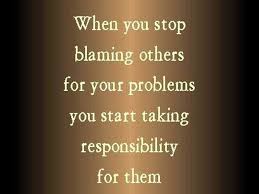
When you stop blaming others, you will then begin your journey to wellness.

When we constantly and consistently blame others for our life problems, we will breed entitlement in our life. Entitlement is an immature “others owe me” mentality. And, they owe me because of what they did to me. Entitlement will breed victimhood. 

Victims do not have to change because…well, they’re victims. Victims remain victims because our culture embraces victimhood as an excuse to live with a life controlling problem. Victims will have a distorted view of reality because they suffered and need others to understand that things happened “to” them. Victimhood will breed unforgiveness. 

Unforgiveness will support us in maintaining a depressed and unthankful heart. It keeps us in the unhealthy state of “That person does not deserve my forgiveness of them.” Unforgiving people are unhappy, unthankful and unhealthy persons.

Maybe your parent was abusive and it started a vicious cycle of hurt and pain. In that case, you are an innocent victim of your parent’s abuse. You may have the option of spending your life blaming your parent(s) and I guess you’d have every right to do so, but staying in blame and not pursuing personal healing only hurts you, not them. 

Jesus was a victim of unjust persecution, as were many in the scriptures.

Jesus knew that ultimately there was a purpose in His suffering and nothing would deter Him from His goal of salvation for all. Even when suffering, Jesus did not adopt a victim mentality. 

Blaming others and walking in longterm victimhood will never allow us to see our own failures, our personal shortcomings. We’ll see the splinter in others’ eyes, but not the log in our own. It will rob us of the initiative to change.

Blaming others and becoming a victim destroys the relationships around us. You cannot dialogue with or challenge someone who is always innocent and right. They simply will not take responsibility for their wrongdoings and wrong words. By the way, this is also why “identity politics” fails so miserably. It constantly creates victims (good people) and oppressors (bad people). There is no healing in this victim-filled mentality.

To heal means you must stop blaming others for your ills and to stop expecting others to fix you or make life right for you.

We need to own our reactions to our hurts and what we tell ourselves about them. To rise above blaming others is to take on the attitude of Christ and His sufferings. Listen to what Peter wrote about suffering.

Do not repay evil with evil, or insult with insult, but with blessing, because to this you were called…But even if you should suffer for what is right, you are blessed. Do not fear what they fear; do not be frightened…[that] those who speak maliciously against your good behavior in Christ may be ashamed of their slander. (I Peter 3: 9,14,16)

So then, those who suffer according to God’s will should commit themselves to their faithful Creator and continue to do good. (I Peter 4:19)

God knows what you suffered at the hands of another. He suffered with you. When we turn our victim status over to Him and receive His healing, we will become victors.


Standard