Challenge, Encouragement, Healing, Issues of the Day, Leadership, Men, Parents, Training, Women

Raising Your Pain Tolerance; The Good Part of Pain (Part III)

We were created to feel pain. Pain in our body is an indicator, a warning that something needs medical attention or intervention. Pain is often a danger signal. It forces a response from us. 

Unfortunately, most persons fear pain, especially emotional pain. Think of losing that loved one, the engagement breakup, or the loss of a job. Often we try to avoid pain; it’s just too, simply put, painful. Perhaps God desires to take us through it? 

Is it really the fear of what happens in our life or is it the fear of the pain that follows significant and pain-filled life experiences that we would rather avoid? 

In this blog, I want us to consider how pain helps to build some very important things in each of us and how it requires our attention. 

God never wastes pain in our lives: Every leader in the Bible went through traumatic and painful experiences. Think of Joseph, Job and Daniel. No Christ follower was or is exempt of pain. God uses it to build us spiritually, emotionally and physically. He builds character through pain-filled life experiences. He often allows tests through those areas where we are weak. Pain produces in us more self-awareness and self-knowledge. If we listen to it, we will learn and grow. Why? Because pain is a strengthener. Seasoned leaders have learned to use the pain in their lives to strengthen their leadership abilities. 

Pain is a strengthener: Pain makes us stronger and tougher. Think of the weightlifter. As they push against the pain, they are building muscle mass. Resistance is a strengthener.  Pain is a precursor to healing. We tend to push against pain, but the pain we can tolerate will strengthen us for the next painful situation we find ourselves in. When we persevere, endure and grow through the pain, it is strengthening us. You will handle pain more effectively in the future. You will handle life challenges more efficiently. 

Pain keeps us humble: It builds humility in us by causing us to be less prideful and more real. We often tend to think well of ourselves and sorry for that poor person who is suffering. Pain lets us know it CAN happen to us. It CAN be a reality check. Pain in our lives will help to build compassion and empathy for others. It hopefully builds a greater sense of love for others and what they go through in life. Often we are looking for empathy because we want significant persons in our lives to know we’re in pain. We need them to notice and to “give us a break.” But God is working humility in our lives.

Pain can be self-inflicted: If it is self-inflicted through our reckless mistakes, then we suffer the consequences and learn from those mistakes. But sometimes pain is self-inflicted because we need to recover from surgery, lose weight or grow in more grace-filled responses. This self-inflicted pain for growth is a positive pain that produces a greater good in our lives. 

Pain teaches self-discipline: We need discipline in our lives. We need boundaries. If we suffered from the lack of control in some area of life, the pain of self-discipline can get us back on track. When we fail in a life discipline or goal, it is not a bad thing to suffer pain. This form of pain can teach us to readjust or plan another strategy. 

Pain grows leadership qualities: The more pain we work through, the greater level of pain tolerance we will experience. The greater level of pain tolerance we grow, the greater level of leadership capacity we will grow. Low tolerance…the lower level of leadership.

Pain draws boundaries: When someone is abusing you, it is appropriate to draw a boundary. Pain inflicted upon us for selfish gain or gratification should cause a healthy reaction of setting a boundary from that unhealthy person. Pain will sharpen your senses and cause a greater alertness to yourself and to others. 

Further, to go through personal pain we will appreciate the non-painful times more. We will appreciate pleasure and happiness more. When we suffer the pain of heartache, we will appreciate even more the deep and joyful feeling of love. If we go to great lengths to avoid pain, we might miss what God is wanting to build in our lives. 

Take responsibility for the pain in your life. Long-term victims remain long-term victims by blaming others for their pain. While others have inflicted the pain, at some point we will have to face it and mature through it rather than blaming others. The longer we blame others for our pain, the longer we can stay stuck in our pain.

One day there will be no more pain. “He will wipe every tear from their eyes. There will be no more death or mourning or crying or pain, for the old order of things has passed away.” (Revelation 21:4)

Until then, “…We also rejoice in our sufferings, because we know that suffering produces perseverance; perseverance, character; and character hope.” (Romans 5:3)

Standard
Challenge, Children, Encouragement, Healing, Issues of the Day, Parents, Pornography

Children and Pornography – It’s Traumatizing Effects

According to the research, most children are exposed to pornography by age 11. Many are exposed accidentally on the internet and many are exposed by coming into contact with their parents’ pornographic material. Those who are sexual predators specifically target young children via porn for the purpose of exploitation. 

A friend of mine told me he was only nine years of age when a friend shared his grandfather’s stash of porn with him found in their barn.

The Effects of Seeing Pornography as a Child

Children do not possess the emotional or cognitive capacity to assimilate pornography in any form. Children report feeling embarrassment, shock, fear, anger, overwhelming sadness and repulsion after being exposed to porn. Young children who view pornography are more likely to sexually assault their peers and siblings. 

According to the American College of Pediatrics, “Consumption of pornography is associated with many negative emotional and psychological…outcomes. These include increased rates of depression, anxiety, acting out and violent behavior…sexual promiscuity…and a distorted view of relationships between men and women. For adults, pornography addiction results in an increased likelihood of divorce which is also harmful to children.”

When my friend was around age 12 he and his friends hid pornographic magazines in their tree house. He said, “We would invite girls into our tree house so we could act out what we saw in the magazines.”

Pornography use as teenagers distorts their view of healthy sexuality and seriously affects, in multiple negative ways, personal relationships. Pornography use fosters the belief that sexual promiscuity is normal and that sexual abstinence is abnormal. Teenagers involved in pornography have difficulty forming lasting, healthy opposite sex relationships which results in higher rates of poor self-images. 

How is Pornography Harming Our Children?

Children viewing pornography are severely harming their brain development. Young, developing minds are hypersensitive to stimuli. That means children can form habits, both positive and negative, very quickly. 

A child’s view of sexuality as normative between husband and wife is ruined by pornography. Pornography presents anything but normality. For young boys, it makes girls an object. Children are taught that sexuality is all about them. It can be violent in nature and it teaches that sex should be expected in a relationship.

Pornography use creates a secretive lifestyle which promotes hiding, lying, and denial. Viewing pornography removes the child from necessary play activities. It can be sleep disruptive. It will reduce scholastic performance by stealing time from school work. 

Viewing pornography increases other unhealthy, abnormal behaviors like sexting. Children learn and grow by mimicking the behavior they see and experience. While children are naturally inclined to explore their bodies, pornography will take them far beyond any natural exploration. 

What You Can Do

  • Talk to your children about pornography. Ask lots of questions. Be persistent.
  • Place a program on your computer that aggressively withholds access to pornography. 
  • Remove data access on their smartphones.
  • Talk to your children about their peers and what they might be exposing your child to.
  • Be calm about discussing the topic and reassure your child of your love no matter what they say.
  • If your child confesses use to you, thank them for their honesty.
  • Work at not placing more shame or judgement upon them. 
  • Find resources to help you as the parent and your child. Talk to your pastor and your local church counselor. Ask for recommendations to help your child and yourself. 

Please see a comprehensive article I wrote on pornography here.

Standard
Challenge, Children, Healing, Issues of the Day, Marriage, Men, Pornography, Women

Women and Pornography

It’s easy to assume that mostly men, young and older, have issues with pornography viewing. But the truth is, more and more women and young girls are getting caught in this addiction as well. Truthfully, the battle with sexual sins affects both men and women, boys and girls.

  • United Families International reports that 1 in 3 porn viewers are women. 
  • Barna Group has revealed that 63% of men aged 18-30 view pornography several times per week while 33% of women do the same.
  • 40 million Americans claim to be regular visitors to porn sites.
  • The computer program Covenant Eyes reports that men prefer images and women prefer erotic stories and romance sites.
  • Six in ten young adults (age 18-24 males and females) seek out porn daily, weekly or monthly. (Barna)

It’s not new. In the Old Testament of the Bible, there was a woman named Gomer who was pretty well known to be unrestrained when it came to sexual misconduct. In spite of her lifestyle, the Lord instructed Hosea, her husband, to show his love to her even as the Lord loved Israel. (Hosea 3:1) 

In John chapter eight we are told the story of an adulterous woman who according to the customs of the day should have been stoned to death. Jesus, to her rescue, told those watching and waiting to throw those stones, said they could do just that…if they had no sin themselves. Every person in this biblical scene dropped their rocks because we all have sinned (Romans 3:23). Jesus did not condemn her, but did say she was to go and “sin no more” (John 8:11).

Sexual sin is not new and it can affect every one of us. But, it can also be forgiven and dealt with by our Savior because He took (endured) our shame, our sorrows and our sins on the cross (Hebrews 12:2). Therein lies our answer. Like Gomer and the adulterous woman Jesus addressed, He will convict us of our wrongdoing rather than condemning us. Conviction comes to show us or to underline our sin so we will seek forgiveness through His cross and be cleansed of our sin. 

To be honest, I believe the cultures we live in today push this lifestyle. When nothing is sacred, when God-given morals are made fun of, and when there is no example of biblically held values on our TV’s and movie entertainment, it is no wonder generation after generation becomes more and more numb to sexual erotica and sexual exposure. To the world around us, it’s simply one more form of entertainment, even sometimes referred to as educational!

This “entertainment” is destroying children, teens and marriages. Sex trafficking has now become the largest issue around the world today. Pornography use directly feeds this issue. 

Men need healing and support groups, but so do women. Yes, women are betrayed by men and husbands who are involved in pornography, but pornography use among women is growing rapidly. God designed sex, not for sin, but rather to be something sacredly held within marriage where one man is committed to one woman.

God’s design of sex carries no regrets, no diseases, and no shame with it. 

Adam and his wife both were naked, and they felt no shame (Genesis 2:25).

Please see a comprehensive article I wrote on pornography here.

Standard
Challenge, Encouragement, Healing, Issues of the Day, Men, Parents, Pornography, Women

View It; Just Don’t Do It?

There is not one alcoholic who ever thought their first drink would lead to alcoholism and yet it can.

When did you first view pornography? Was it with friends or were you by yourself? Was it planned or did it happen inadvertently? Did you then desire to look again and again and again?

Viewing pornography repeatedly causes one to lose control. Control of what?

  • Control of our thought life.
  • Control of our eyes.
  • Control of the spirit of lust.
  • Control of the lies one uses to cover up the practice.
  • For some, the loss of financial control. 
  • Control of our sexual lives.

Do you really want to lose control over your life through an addiction? Do you really want to destroy your marriage? Do you want to open the door to porn use for your children? 

When we allow a perversion into our home, we give the evil one freedom to destroy our home. We will be opening the door to ruined relationships and quite possibly a ruined family. 

Confess your need for help to your pastor or a counselor and receive intervention. Pornography is not something God hands you; it is something the devil himself hands you. 

The ongoing viewing of pornography will not take you where God desires you to go. God treasures your heart; He wants to dwell there and remove the trash the enemy has handed you. Pornography viewing is beneath who you are and Whose you are.

Please see a comprehensive article I wrote on pornography here.

Standard
Encouragement, Healing, History, Issues of the Day, Just for fun

Tide, It Gets the Dirt Out…But Not All of It

I recently read an article about the very first laundry detergent. It was Procter and Gamble’s desire to create a product that would not leave soap scum in the clothes being washed. Soap prior to the 1930’s left behind dirt, fats and oils in the clothing. These residues would not dissolve in water. 

It would take P&G scientists and chemists ten years to develop a formula that could actually “grab” the dirt and leave clothes clean without soap residue left in the fabric. This revolutionary product was named Tide

Tide is now an international name. In 2018 Americans bought $1.7 billion worth of the laundry product now offered in multiple forms. It is simply the most trusted laundry detergent brand. 

There is a hymn we used to sing back in the day and I for one loved it. The first verse was:

What can wash away my sin?
Nothing but the blood of Jesus;
What can make me whole again?
Nothing but the blood of Jesus.

Tide might get the dirt out of your clothing but it won’t touch your soul. There is only one product that can do that: the blood shed by Jesus on the cross. Easter 2024 has come and gone, but the celebration of a soul cleansing, a heart washing and a mind renewing begins at the cross.

Standard
Challenge, Children, Healing, Issues of the Day, Just for fun, Parents

The Ragman

by Walter Wangerin, Jr.

My wife and I stumbled upon this amazing story many years ago. We actually turned it into a skit with our foster children and performed it at our local church. I find it intriguing and hopeful and so appropriate for Easter. Enjoy!

I saw a strange sight. I stumbled upon a story most strange, like nothing in my life, my street sense, my sly tongue had ever prepared me for. Hush now, and I will tell it to you.

Even before the dawn one Friday morning, I noticed a young man, handsome and strong, walking the alleys of our city. He was pulling an old cart filled with clothes both bright and new, and he was calling in a clear tenor voice: “Rags!”

“Rags! New rags for old! I take your old, dirty, and tired rags! Rags!”

Now this is a wonder, I thought to myself, for the man stood six-feet-four, and his arms were like tree limbs, hard and muscular. His eyes flashed love and wonderment. Could he find no better job than this? To be a ragman in the inner city?

I followed him. My curiosity drove me. And I wasn’t disappointed. For what I was about to see was miraculous.

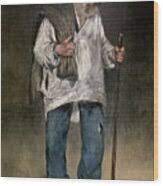
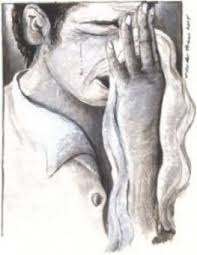
Soon the ragman saw a woman sitting on her back porch. She was sobbing into a handkerchief, sighing, and shedding a thousand tears. Her knees and elbows made a sad X. Her shoulders shook. Her heart was breaking.

The ragman stopped his cart. Quietly, he walked to the woman, stepping round tin cans, dead toys, and baby diapers.

“Give me your rag,” he said gently, “and I’ll give you another.”

He slipped the handkerchief from her eyes. She looked up, and he laid across her palm a linen cloth so clean and new that it shined. She blinked from the gift to the giver.

Then, as he began to pull his cart again, the ragman did a strange thing: he put her stained handkerchief to his own face and he began to weep, to sob as grievously as she had done. His shoulders were shaking vigorously. Yet she was left without a tear.

This is a wonder, I breathed to myself, and I followed the sobbing ragman like a child who cannot turn away from a mystery.

‘Rags! Rags! New rags for old!”

In a little while, when the sky showed grey behind the rooftops and I could see the shredded curtains hanging out black windows, the ragman came upon a girl whose head was wrapped in a bandage, whose eyes were empty. Blood soaked her bandage. A single line of blood ran down her cheek.

Now the ragman full of compassion looked upon this child with pity, as he drew a lovely yellow bonnet from his cart.

“Give me your rag,” he said, tracing his own line on her cheek, “and I’ll give you mine.”

The child could only gaze at him while he loosened the bandage, removed it, and tied it to his own head, while placing the bonnet upon her. I gasped at what I saw: for with the bandage went the wound! Against his brow it ran a darker, more substantial blood – his own!

“Rags! Rags! I take old rags!” cried the sobbing, bleeding, strong ragman.

The sun hurt both the sky now, and my eyes; the ragman seemed more and more in a hurry.

“Are you going to work?” he asked a man who leaned against a telephone pole. The man shook his head. The ragman pressed him: “Do you have a job?”

“Are you crazy?” sneered the man. He pulled away from the pole, revealing the right sleeve of his jacket – flat, the cuff stuffed into the pocket. He had no arm.

“So,” said the ragman. “Give me your jacket, and I’ll give you mine.”

The one-armed man took off his jacket as did the ragman. I trembled at what I was now seeing: the ragman’s arm stayed in its sleeve, and when the other put the ragman’s jacket on, he now had two good arms, thick as tree limbs.

“Go to work,” said the now one-armed ragman.

Stumbling upon a drunk, the ragman found lying unconscious beneath an army blanket an old man hunched in a fetal position. He took that blanket and wrapped it round himself, but for the drunk he left new clothes.

And now I had to run to keep up with the ragman. Though he was weeping uncontrollably, and bleeding freely at the forehead, pulling his cart with one arm, stumbling for drunkenness, falling again and again, exhausted, looking older, and sick, yet he moved with a steady pace. He eventually came to the city limits, and then he rushed beyond.

I wept to see the change in this man. I hurt to see his sorrow. And yet I needed to see where he was going in such haste, perhaps to know what drove him onward.

The ragman came to a landfill; the garbage pits. I wanted to help him in what he was attempting to do but I hung back, hiding. He climbed a hill. With tormented labor he cleared a little space on that hill. Then, he layed down and pillowed his head on a handkerchief and a jacket. He covered his bones with an army blanket and then he died.

How I cried to witness that death! I slumped over and wailed as one who has no hope. I had come to admire the ragman. I sobbed myself to sleep.

I did not know, how could I know? I slept through Friday night and Saturday night too.

But then, on Sunday morning, I was wakened by a violently supernatural bright light.

Light – pure, bright, demanding light slammed against my face. I blinked and I looked and I saw the ragman, folding his blanket most carefully, a scar on his forehead, but alive! There was no sign of sorrow or age and all the rags he had gathered shined, cleansed and bright.

I walked up to the ragman. I told him my name. I felt compeled to remove my clothes. I said to him with longing in my voice: “Dress me.”

He dressed me. My Lord, he put new rags on me, and I am a wonder beside him. The ragman, the ragman, the Christ!


Standard
Challenge, Encouragement, Healing, Issues of the Day, Leadership, Training

Leadership Fatigue and Burnout

I can recall an important part of a message that I heard many years ago. I remember one small but impacting statement the speaker made. It went like this: “If the evil one cannot move you away from God, he’ll push you into God!”

What does that mean? 

It means he is relentless at letting you know you’re not doing enough, not praying enough, not studying the Bible enough, and not testifying enough. If he can push you to believe these lies, he can discourage you and cause you to think you simply are not enough. 

The end result is spiritual exhaustion, physical depletion and emotional discouragement. And that can affect your work, your ministry, your marriage and your family. In the last decade over 29,000 evangelical pastors have left the pastorate. Lifeway Research has noted that 71% of churches have no plan for sabbaticals; 66% lack a support group for the pastor’s family and 33% do not have a list of counselors for referrals. 

Leaders burn out, fail and fall. Our leaders are sheep as well and we all need shepherds in our life. 

That’s where sabbaticals come in. It’s not a new idea, just one that is rarely utilized. In the Monterey Herald newspaper article “Beating Burnout,” writer Cindy Kirschner Goodman reports, “Among the Fortune 100 Best Places to Work, 22 companies boast of offering a fully paid sabbatical.” She writes, “These companies find if they don’t do something, their workers will burn out and leave, or even worse burn out and stay.”

A sabbatical is preventative medicine. It is some of the best preventative medicine/maintenance a company or a ministry can initiate for their long-term, full-time workers. 

So, how is it done? I believe in and have written about a four-phase approach:

  1. Disengage and Rest – Disengage from life as normal and then engage in what will provide rest to you physically, mentally and spiritually.
  2. Retooling and Refocusing – After rest, one is often ready for some input into their life that promotes personal growth and health.
  3. Regeneration or Renewal – This is the evaluation phase and then the vision stage; assessing the past and looking toward the future. 
  4. Resolution – This phase is a firm or unwavering determination toward a solved problem or solution toward healthy boundaries to sustain a balanced lifestyle. It is a written plan for your future so you do not return to life as “usual,” but rather implementing the changes that are necessary.

You can catch an in-depth look at sabbaticals in this book

Standard
Challenge, Encouragement, Healing, Issues of the Day, Marriage, Men, Postmarital, Women

Intimacy Anorexia

It’s not my term. Author and speaker Dr. Doug Weiss coined the term and states it’s why some people “actively withhold emotional, spiritual, and sexual intimacy” from their partner. He writes that some of those issues can be identified as:

  • Keeping themselves busy with child care, household tasks, technology or work. Too busy for you, but not others.
  • Blaming you [or others] for the loss of intimacy rather than exploring potential patterns in their own behavior.
  • Withholding love, especially in the way you desire to receive it.
  • They stop complementing you.
  • Have little to no interest in sex.
  • Show little interest in connecting on a spiritual level.
  • Avoid talking about their feelings and not connecting on an emotional level.
  • Treat you more like a roommate and not a romantic partner.
  • Have money control issues or desire to control the money.
  • Have anger outbursts, ignore you or give you the silent treatment.

Wiess states it doesn’t take all these issues, maybe just five of them to experience sexual anorexia. He believes many persons who survive some form of sexual abuse will respond in this way to their marriage partners. 

Further, these relationships can be full of frequent criticism, including criticism of things one cannot change. 

Persons who exhibit these types of behaviors have more than likely experienced something traumatic in their growing up years. In their adult world, however, they are attempting to avoid the pain of their misguided view by avoiding intimacy. 

Intimacy requires trust in a relationship. It requires vulnerability. It requires safety and, of course, that all important ingredient: love.

Sexual intimacy within the boundary of marriage brings glory to God.

Sexual intimacy within the boundary of marriage draws marriages closer to God and one another.

Sexual intimacy within the boundary of marriage is always centered on your spouse.

Sexual intimacy within the boundary of marriage promotes deeper love, commitment and pleasure.

If you find yourself battling with any of the above descriptions of intimacy anorexia, please see a counselor who is familiar with the subject.  

Standard
Challenge, Encouragement, Healing, Marriage, Men, Postmarital, Women

Marriage Disappointment

Marriage is never 100% awesome and amazing. It’s hard sometimes and sometimes we say the wrong things. Sometimes we think the wrong things or do the wrong things. For everyone who is married, we are all on a learning path, a growing path. If your marriage has become critical or stale, it’s up to you to change that. If your marriage has become a disappointment in some form or fashion, perhaps you’ve veered from the path and have lost your way on the journey. 

The story is told that in his later years the legendary Babe Ruth had became overweight, slower, and struck out far more frequently. The baseball fans began to jeer him.

Apparently, the displeasure of the fans got to a small boy who leaped over the railing and ran onto the field to wrap his arms around the legs of this declining athlete. With tears plentiful in his eyes, the little boy expressed his love for the man that he knew he once was. The Babe picked the little boy up and embraced him as well. Together they walked hand in hand to the dugout. The crowd’s displeasure turned to cheers for the display of unconditional love on the field that day.

Your marital love is like that picture. Our marriage becomes “overweight” or “slower” and we “strike out” sometimes with our words and our actions or lack thereof. We fail each other occasionally. We make errors in the game of marriage and we disappoint one another. 

But regardless of how we may feel, every once in a while we need to wrap our arms around each other and express our undying love and remain faithfully on the journey of growing older together. 

                HAPPY VALENTINE’S DAY!

Standard
Challenge, Encouragement, Healing, Identity, In the news, Issues of the Day, Leadership, Parents

Wasting Your Life Blaming Others

I can’t begin to tell you how many people who entered my counseling office over numerous years attributed all of their life issues to another person or persons. It can always be someone else’s fault. Why? We are very good at finding others to blame.

We can blame:

  • Our parents
  • Our spouse
  • Our ex-spouse
  • Our boss
  • Our coworkers

The list could go on and on. But here is a word of counsel that you can take to the bank:

As long as we feel we can blame another for our problems, we will never know wholeness for that area of our lives.

Said another way:

When you stop blaming others, you will then begin your journey to wellness.

When we constantly and consistently blame others for our life problems, we will breed entitlement in our life. Entitlement is an immature “others owe me” mentality. And, they owe me because of what they did to me. Entitlement will breed victimhood. 

Victims do not have to change because…well, they’re victims. Victims remain victims because our culture embraces victimhood as an excuse to live with a life controlling problem. Victims will have a distorted view of reality because they suffered and need others to understand that things happened “to” them. Victimhood will breed unforgiveness. 

Unforgiveness will support us in maintaining a depressed and unthankful heart. It keeps us in the unhealthy state of “That person does not deserve my forgiveness of them.” Unforgiving people are unhappy, unthankful and unhealthy persons.

Maybe your parent was abusive and it started a vicious cycle of hurt and pain. In that case, you are an innocent victim of your parent’s abuse. You may have the option of spending your life blaming your parent(s) and I guess you’d have every right to do so, but staying in blame and not pursuing personal healing only hurts you, not them. 

Jesus was a victim of unjust persecution, as were many in the scriptures.

Jesus knew that ultimately there was a purpose in His suffering and nothing would deter Him from His goal of salvation for all. Even when suffering, Jesus did not adopt a victim mentality. 

Blaming others and walking in longterm victimhood will never allow us to see our own failures, our personal shortcomings. We’ll see the splinter in others’ eyes, but not the log in our own. It will rob us of the initiative to change.

Blaming others and becoming a victim destroys the relationships around us. You cannot dialogue with or challenge someone who is always innocent and right. They simply will not take responsibility for their wrongdoings and wrong words. By the way, this is also why “identity politics” fails so miserably. It constantly creates victims (good people) and oppressors (bad people). There is no healing in this victim-filled mentality.

To heal means you must stop blaming others for your ills and to stop expecting others to fix you or make life right for you.

We need to own our reactions to our hurts and what we tell ourselves about them. To rise above blaming others is to take on the attitude of Christ and His sufferings. Listen to what Peter wrote about suffering.

Do not repay evil with evil, or insult with insult, but with blessing, because to this you were called…But even if you should suffer for what is right, you are blessed. Do not fear what they fear; do not be frightened…[that] those who speak maliciously against your good behavior in Christ may be ashamed of their slander. (I Peter 3: 9,14,16)

So then, those who suffer according to God’s will should commit themselves to their faithful Creator and continue to do good. (I Peter 4:19)

God knows what you suffered at the hands of another. He suffered with you. When we turn our victim status over to Him and receive His healing, we will become victors.

Standard