Encouragement, Healing, History, Issues of the Day, Just for fun

Tide, It Gets the Dirt Out…But Not All of It

I recently read an article about the very first laundry detergent. It was Procter and Gamble’s desire to create a product that would not leave soap scum in the clothes being washed. Soap prior to the 1930’s left behind dirt, fats and oils in the clothing. These residues would not dissolve in water. 

It would take P&G scientists and chemists ten years to develop a formula that could actually “grab” the dirt and leave clothes clean without soap residue left in the fabric. This revolutionary product was named Tide

Tide is now an international name. In 2018 Americans bought $1.7 billion worth of the laundry product now offered in multiple forms. It is simply the most trusted laundry detergent brand. 

There is a hymn we used to sing back in the day and I for one loved it. The first verse was:

What can wash away my sin?
Nothing but the blood of Jesus;
What can make me whole again?
Nothing but the blood of Jesus.

Tide might get the dirt out of your clothing but it won’t touch your soul. There is only one product that can do that: the blood shed by Jesus on the cross. Easter 2024 has come and gone, but the celebration of a soul cleansing, a heart washing and a mind renewing begins at the cross.

Standard
Challenge, Children, Healing, Issues of the Day, Just for fun, Parents

The Ragman

by Walter Wangerin, Jr.

My wife and I stumbled upon this amazing story many years ago. We actually turned it into a skit with our foster children and performed it at our local church. I find it intriguing and hopeful and so appropriate for Easter. Enjoy!

I saw a strange sight. I stumbled upon a story most strange, like nothing in my life, my street sense, my sly tongue had ever prepared me for. Hush now, and I will tell it to you.

Even before the dawn one Friday morning, I noticed a young man, handsome and strong, walking the alleys of our city. He was pulling an old cart filled with clothes both bright and new, and he was calling in a clear tenor voice: “Rags!”

“Rags! New rags for old! I take your old, dirty, and tired rags! Rags!”

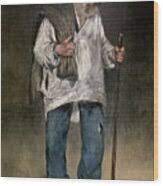
Now this is a wonder, I thought to myself, for the man stood six-feet-four, and his arms were like tree limbs, hard and muscular. His eyes flashed love and wonderment. Could he find no better job than this? To be a ragman in the inner city?

I followed him. My curiosity drove me. And I wasn’t disappointed. For what I was about to see was miraculous.

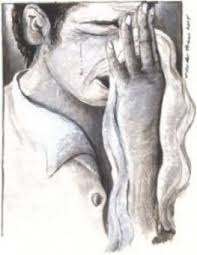
Soon the ragman saw a woman sitting on her back porch. She was sobbing into a handkerchief, sighing, and shedding a thousand tears. Her knees and elbows made a sad X. Her shoulders shook. Her heart was breaking.

The ragman stopped his cart. Quietly, he walked to the woman, stepping round tin cans, dead toys, and baby diapers.

“Give me your rag,” he said gently, “and I’ll give you another.”

He slipped the handkerchief from her eyes. She looked up, and he laid across her palm a linen cloth so clean and new that it shined. She blinked from the gift to the giver.

Then, as he began to pull his cart again, the ragman did a strange thing: he put her stained handkerchief to his own face and he began to weep, to sob as grievously as she had done. His shoulders were shaking vigorously. Yet she was left without a tear.

This is a wonder, I breathed to myself, and I followed the sobbing ragman like a child who cannot turn away from a mystery.

‘Rags! Rags! New rags for old!”

In a little while, when the sky showed grey behind the rooftops and I could see the shredded curtains hanging out black windows, the ragman came upon a girl whose head was wrapped in a bandage, whose eyes were empty. Blood soaked her bandage. A single line of blood ran down her cheek.

Now the ragman full of compassion looked upon this child with pity, as he drew a lovely yellow bonnet from his cart.

“Give me your rag,” he said, tracing his own line on her cheek, “and I’ll give you mine.”

The child could only gaze at him while he loosened the bandage, removed it, and tied it to his own head, while placing the bonnet upon her. I gasped at what I saw: for with the bandage went the wound! Against his brow it ran a darker, more substantial blood – his own!

“Rags! Rags! I take old rags!” cried the sobbing, bleeding, strong ragman.

The sun hurt both the sky now, and my eyes; the ragman seemed more and more in a hurry.

“Are you going to work?” he asked a man who leaned against a telephone pole. The man shook his head. The ragman pressed him: “Do you have a job?”

“Are you crazy?” sneered the man. He pulled away from the pole, revealing the right sleeve of his jacket – flat, the cuff stuffed into the pocket. He had no arm.

“So,” said the ragman. “Give me your jacket, and I’ll give you mine.”

The one-armed man took off his jacket as did the ragman. I trembled at what I was now seeing: the ragman’s arm stayed in its sleeve, and when the other put the ragman’s jacket on, he now had two good arms, thick as tree limbs.

“Go to work,” said the now one-armed ragman.

Stumbling upon a drunk, the ragman found lying unconscious beneath an army blanket an old man hunched in a fetal position. He took that blanket and wrapped it round himself, but for the drunk he left new clothes.

And now I had to run to keep up with the ragman. Though he was weeping uncontrollably, and bleeding freely at the forehead, pulling his cart with one arm, stumbling for drunkenness, falling again and again, exhausted, looking older, and sick, yet he moved with a steady pace. He eventually came to the city limits, and then he rushed beyond.

I wept to see the change in this man. I hurt to see his sorrow. And yet I needed to see where he was going in such haste, perhaps to know what drove him onward.

The ragman came to a landfill; the garbage pits. I wanted to help him in what he was attempting to do but I hung back, hiding. He climbed a hill. With tormented labor he cleared a little space on that hill. Then, he layed down and pillowed his head on a handkerchief and a jacket. He covered his bones with an army blanket and then he died.

How I cried to witness that death! I slumped over and wailed as one who has no hope. I had come to admire the ragman. I sobbed myself to sleep.

I did not know, how could I know? I slept through Friday night and Saturday night too.

But then, on Sunday morning, I was wakened by a violently supernatural bright light.

Light – pure, bright, demanding light slammed against my face. I blinked and I looked and I saw the ragman, folding his blanket most carefully, a scar on his forehead, but alive! There was no sign of sorrow or age and all the rags he had gathered shined, cleansed and bright.

I walked up to the ragman. I told him my name. I felt compeled to remove my clothes. I said to him with longing in my voice: “Dress me.”

He dressed me. My Lord, he put new rags on me, and I am a wonder beside him. The ragman, the ragman, the Christ!

Standard
Challenge, Encouragement, Healing, Issues of the Day, Leadership, Training

Leadership Fatigue and Burnout

I can recall an important part of a message that I heard many years ago. I remember one small but impacting statement the speaker made. It went like this: “If the evil one cannot move you away from God, he’ll push you into God!”

What does that mean? 

It means he is relentless at letting you know you’re not doing enough, not praying enough, not studying the Bible enough, and not testifying enough. If he can push you to believe these lies, he can discourage you and cause you to think you simply are not enough. 

The end result is spiritual exhaustion, physical depletion and emotional discouragement. And that can affect your work, your ministry, your marriage and your family. In the last decade over 29,000 evangelical pastors have left the pastorate. Lifeway Research has noted that 71% of churches have no plan for sabbaticals; 66% lack a support group for the pastor’s family and 33% do not have a list of counselors for referrals. 

Leaders burn out, fail and fall. Our leaders are sheep as well and we all need shepherds in our life. 

That’s where sabbaticals come in. It’s not a new idea, just one that is rarely utilized. In the Monterey Herald newspaper article “Beating Burnout,” writer Cindy Kirschner Goodman reports, “Among the Fortune 100 Best Places to Work, 22 companies boast of offering a fully paid sabbatical.” She writes, “These companies find if they don’t do something, their workers will burn out and leave, or even worse burn out and stay.”

A sabbatical is preventative medicine. It is some of the best preventative medicine/maintenance a company or a ministry can initiate for their long-term, full-time workers. 

So, how is it done? I believe in and have written about a four-phase approach:

  1. Disengage and Rest – Disengage from life as normal and then engage in what will provide rest to you physically, mentally and spiritually.
  2. Retooling and Refocusing – After rest, one is often ready for some input into their life that promotes personal growth and health.
  3. Regeneration or Renewal – This is the evaluation phase and then the vision stage; assessing the past and looking toward the future. 
  4. Resolution – This phase is a firm or unwavering determination toward a solved problem or solution toward healthy boundaries to sustain a balanced lifestyle. It is a written plan for your future so you do not return to life as “usual,” but rather implementing the changes that are necessary.

You can catch an in-depth look at sabbaticals in this book

Standard
Challenge, Encouragement, Healing, Issues of the Day, Marriage, Men, Postmarital, Women

Intimacy Anorexia

It’s not my term. Author and speaker Dr. Doug Weiss coined the term and states it’s why some people “actively withhold emotional, spiritual, and sexual intimacy” from their partner. He writes that some of those issues can be identified as:

  • Keeping themselves busy with child care, household tasks, technology or work. Too busy for you, but not others.
  • Blaming you [or others] for the loss of intimacy rather than exploring potential patterns in their own behavior.
  • Withholding love, especially in the way you desire to receive it.
  • They stop complementing you.
  • Have little to no interest in sex.
  • Show little interest in connecting on a spiritual level.
  • Avoid talking about their feelings and not connecting on an emotional level.
  • Treat you more like a roommate and not a romantic partner.
  • Have money control issues or desire to control the money.
  • Have anger outbursts, ignore you or give you the silent treatment.

Wiess states it doesn’t take all these issues, maybe just five of them to experience sexual anorexia. He believes many persons who survive some form of sexual abuse will respond in this way to their marriage partners. 

Further, these relationships can be full of frequent criticism, including criticism of things one cannot change. 

Persons who exhibit these types of behaviors have more than likely experienced something traumatic in their growing up years. In their adult world, however, they are attempting to avoid the pain of their misguided view by avoiding intimacy. 

Intimacy requires trust in a relationship. It requires vulnerability. It requires safety and, of course, that all important ingredient: love.

Sexual intimacy within the boundary of marriage brings glory to God.

Sexual intimacy within the boundary of marriage draws marriages closer to God and one another.

Sexual intimacy within the boundary of marriage is always centered on your spouse.

Sexual intimacy within the boundary of marriage promotes deeper love, commitment and pleasure.

If you find yourself battling with any of the above descriptions of intimacy anorexia, please see a counselor who is familiar with the subject.  

Standard
Challenge, Encouragement, Healing, Marriage, Men, Postmarital, Women

Marriage Disappointment

Marriage is never 100% awesome and amazing. It’s hard sometimes and sometimes we say the wrong things. Sometimes we think the wrong things or do the wrong things. For everyone who is married, we are all on a learning path, a growing path. If your marriage has become critical or stale, it’s up to you to change that. If your marriage has become a disappointment in some form or fashion, perhaps you’ve veered from the path and have lost your way on the journey. 

The story is told that in his later years the legendary Babe Ruth had became overweight, slower, and struck out far more frequently. The baseball fans began to jeer him.

Apparently, the displeasure of the fans got to a small boy who leaped over the railing and ran onto the field to wrap his arms around the legs of this declining athlete. With tears plentiful in his eyes, the little boy expressed his love for the man that he knew he once was. The Babe picked the little boy up and embraced him as well. Together they walked hand in hand to the dugout. The crowd’s displeasure turned to cheers for the display of unconditional love on the field that day.

Your marital love is like that picture. Our marriage becomes “overweight” or “slower” and we “strike out” sometimes with our words and our actions or lack thereof. We fail each other occasionally. We make errors in the game of marriage and we disappoint one another. 

But regardless of how we may feel, every once in a while we need to wrap our arms around each other and express our undying love and remain faithfully on the journey of growing older together. 

                HAPPY VALENTINE’S DAY!

Standard
Challenge, Encouragement, Healing, Identity, In the news, Issues of the Day, Leadership, Parents

Wasting Your Life Blaming Others

I can’t begin to tell you how many people who entered my counseling office over numerous years attributed all of their life issues to another person or persons. It can always be someone else’s fault. Why? We are very good at finding others to blame.

We can blame:

  • Our parents
  • Our spouse
  • Our ex-spouse
  • Our boss
  • Our coworkers

The list could go on and on. But here is a word of counsel that you can take to the bank:

As long as we feel we can blame another for our problems, we will never know wholeness for that area of our lives.

Said another way:

When you stop blaming others, you will then begin your journey to wellness.

When we constantly and consistently blame others for our life problems, we will breed entitlement in our life. Entitlement is an immature “others owe me” mentality. And, they owe me because of what they did to me. Entitlement will breed victimhood. 

Victims do not have to change because…well, they’re victims. Victims remain victims because our culture embraces victimhood as an excuse to live with a life controlling problem. Victims will have a distorted view of reality because they suffered and need others to understand that things happened “to” them. Victimhood will breed unforgiveness. 

Unforgiveness will support us in maintaining a depressed and unthankful heart. It keeps us in the unhealthy state of “That person does not deserve my forgiveness of them.” Unforgiving people are unhappy, unthankful and unhealthy persons.

Maybe your parent was abusive and it started a vicious cycle of hurt and pain. In that case, you are an innocent victim of your parent’s abuse. You may have the option of spending your life blaming your parent(s) and I guess you’d have every right to do so, but staying in blame and not pursuing personal healing only hurts you, not them. 

Jesus was a victim of unjust persecution, as were many in the scriptures.

Jesus knew that ultimately there was a purpose in His suffering and nothing would deter Him from His goal of salvation for all. Even when suffering, Jesus did not adopt a victim mentality. 

Blaming others and walking in longterm victimhood will never allow us to see our own failures, our personal shortcomings. We’ll see the splinter in others’ eyes, but not the log in our own. It will rob us of the initiative to change.

Blaming others and becoming a victim destroys the relationships around us. You cannot dialogue with or challenge someone who is always innocent and right. They simply will not take responsibility for their wrongdoings and wrong words. By the way, this is also why “identity politics” fails so miserably. It constantly creates victims (good people) and oppressors (bad people). There is no healing in this victim-filled mentality.

To heal means you must stop blaming others for your ills and to stop expecting others to fix you or make life right for you.

We need to own our reactions to our hurts and what we tell ourselves about them. To rise above blaming others is to take on the attitude of Christ and His sufferings. Listen to what Peter wrote about suffering.

Do not repay evil with evil, or insult with insult, but with blessing, because to this you were called…But even if you should suffer for what is right, you are blessed. Do not fear what they fear; do not be frightened…[that] those who speak maliciously against your good behavior in Christ may be ashamed of their slander. (I Peter 3: 9,14,16)

So then, those who suffer according to God’s will should commit themselves to their faithful Creator and continue to do good. (I Peter 4:19)

God knows what you suffered at the hands of another. He suffered with you. When we turn our victim status over to Him and receive His healing, we will become victors.

Standard
Challenge, Encouragement, Healing, Identity, Issues of the Day, Pornography, Training

Understanding and Breaking Bad Habits

Most smokers desire not to smoke and most persons know that overeating is harming their bodies. But unhealthy habits are especially hard to stop. Why?

We all have habits, good and not so good. Taking a shower and shaving along with brushing our teeth are all healthy habits. Habits begin with routines done over and over. When we develop a routine, the brain becomes conditioned so that our actions become automatic. In other words, our brains work far less hard when a routine is established. 

Establishing good and bad habits really follow the same course. The major difference is when certain habits are pleasure-based. Enjoyable and repeated behaviors cause dopamine to be released by the brain. This feel-good chemical, dopamine, creates the craving to repeat the action. 

When we’re attempting to quit a habit, we are attempting to force our hardwired brains to do something that it’s been trained to do otherwise. Then, when you add the pleasure-giving dopamine chemical to the equation, the battle becomes even more difficult. 

Further, adding triggers to the routine cause more habit breaking problems as well. What do I mean by triggers? For example, when feeling nervous or anxious some people bite their nails. The anxiety one feels triggers the reaction of nail biting. 

When a habit like viewing pornography begins, there are often triggers from feeling rejection created, but then there is the added feel-good reward of a dopamine wash as one viewes the images. So, certain routines cause certain triggers which can cause certain rewards.

Breaking Unwanted Habits

First and foremost, know and understand why you want to break a habit. The why is important because it could be coming from conviction, from a guilty conscience, or from fear of getting caught. Second, what is the benefit of breaking the unwanted behavior? These steps are a part of deciding that this specific habit is not a good one and your personal conviction is to stop it.

Note: realize there is a difference between sin, breaking God’s commands, and a bad habit. Recognize some bad habits are not sinful. 

Third, ask yourself how you have been justifying this habit. What excuses have you been using to continue it? For example, I can eat several candy bars because I fasted a meal yesterday. Or, I can watch porn because my spouse is rejecting me. Discovering these justifiers will help you to be able to fully admit that this habit is rooted in a negative or harmful thought process.

Fourth, don’t blame others for your negative habits. You must personally take responsibility. If you regularly blame others for your porn addiction, you’ll never quit. If you blame others for your anger, your anger issues will not change. You must take ownership for your habits.

Fifth, stay away from the triggers. Remember, it was stated earlier that certain triggers, especially those which also contain reward, can cause us to act in the routine of certain bad habits. So, if there are specific persons (relationships) or places which help to promote those triggers, work at staying away from them. 

Sometimes when we connect a negative habit with who it affects, it can help us to stop. For example, if our anger has begun to cause our children to become afraid of us (anger causing fear), then we realize change needs to occur so that our children know and respond to our love.  

Sixth, enlist a faithful friend to hold you accountable. Ask someone who will not judge you but rather care enough to lend support toward change. 

Step seven can be to replace the bad habit with a good one. This is an attempt at rewiring the brain away from the unwanted behavior toward the desired behavior. 

Eight, practice self-control. The more you practice self-control, the more you exercise the brain to develop a new habit (like a muscle exercising). Both the new and the old habit are in your brain; practicing the new enlarges the self-control muscle. This is also the principle of sowing and reaping. As you sow the good habit, you will reap the good results. 

Nine, keep enlisting God’s help. Keep depending upon the Holy Spirit to protect you, to provide new ways to respond and to give you new thoughts.

Ten. Lastly, one of the best ways to put to death a negative habit is to reinforce your healing, your change and your renewed mind by helping others in that very same area!

“…Clothe yourselves with the Lord Jesus Christ, and do not think about how to gratify the desires of the flesh.” (Romans 13:14) And, “Whatever you do, work at it with all your heart, as working for the Lord…” (Colossians 3:23) 

Standard
Challenge, Encouragement, Healing, Issues of the Day, Men, Parents, Singles, Small Groups, Training, Women

Change Is Hard: The Law of Constant Use

Have you set goals for 2024? Do you know what you desire to accomplish and when you desire to accomplish it? Maybe you have some goals left over from 2023. I know I do. 

But what about personal life goals? How do we see growth and change in our personal lives? Dealing with oneself is often a bit more challenging.

First and foremost, let’s remember God changes the heart. He brings His truth to us with His request for change. So, change begins with a heart to obey God and make the changes He is requesting of us. In fact, His word reveals that we show Him how much we love Him by how willing we are to obey Him. (See John 14:15.)

From the conviction in our heart, the scriptures give us a pattern for change and I like to refer to it as The Law of Constant Use.

The Law of Constant Use provides a three-part scriptural process for change from what we are accustomed to doing to what God desires of us. How does it work and how do we start the process of change?

Jeremiah 13:23 reveals, “Can the Ethiopian change his skin or the leopard its spots? Neither can you do good who are accustomed to doing evil.” What are you “accustomed to” doing? We become so accustomed to our actions and our thoughts that we often go through life without asking ourselves whether what we think, what we believe and what we do is correct.

The second verse in this process of change is, “All hard work brings a profit, but mere talk leads only to poverty.” (Proverbs 14:23) It is hard work to change. Don’t let anybody fool you or tell you it’s easy. This verse reminds us that true change is not just talking about change. We all have known those persons who have promised change, but yet never deliver. Why?

When we have programed ourselves to think a certain way or act a certain way, the reprograming part takes effort. We all have believed things that are simply not true about ourselves or others. And yet, we continued in those beliefs until we were confronted with the truth. However, even then we may have struggled to believe something different. We tend to always give ourselves and our beliefs the benefit of the doubt.

There is a third step in this process. Hebrews 5:12-14 wisely records, “In fact, though by this time you ought to be teachers, you need someone to teach you the elementary truths of God’s word all over again. You need milk, not solid food! Anyone who lives on milk, being still an infant, is not acquainted with the teaching about righteousness. But solid food is for the mature, who by constant use have trained themselves to distinguish good from evil.”

The Spirit of God wants to bring forth a new reality, that which you may not be accustomed to. He wants to take you from the milk of His word to the meat, a maturation process of change. He is letting us know that past experience is not necessarily present reality. God in our spirit is retraining us to be accustomed to His voice, His reality and His will. And by “constant use” we can experience change that becomes permanent!

Yes, change is challenging, but when God is at the center of the desired change, He makes a way for correcting our course. He provides a path for change. When we constantly incorporate His truth, His thoughts and His ways, enduring change will take place in our lives.

What do you (or perhaps better asked, what does God) desire to change in you in this brand-new year He has given?

Standard
Challenge, Encouragement, Healing, Identity, In the news, Issues of the Day

Prince of Peace

Over 700 years BEFORE Christ’s birth the prophet Isaiah wrote:

For unto us a child is born, to us a son is given, and the government will be on his shoulders.

And he will be called Wonderful Counselor, Mighty God, Everlasting Father, Prince of Peace. (Isaiah 9:6)

Handel’s Messiah included these words and choirs have been singing them since the year 1741.

Our English word, peace, has far more meaning than we realize. In Hebrew, the word is “Shalom.” It is often used by Jews and other nationalities as a word of greeting. Shalom has many beautiful and meaningful definitions. In the Hebrew, it is far more than just peace. It can mean completeness, cessation, repose, safety, soundness, tranquility, prosperity, fullness, harmony, lack of worry, and the absence of anxiety. That takes peace to a whole new level!

This peace from the Christ child has amazing meaning for our lives today. It is:

  1. Restorative – Through His peace we are restored to the Father. “For he himself is our peace…He came and preached peace to you who were far away and peace to those who were near. For through him we both have access to the Father by one Spirit.” (Ephesians 2: 14-18)
  • Harmony – We can have harmony and peace with all of life’s circumstances and disappointments. When we rest in Him, find our completeness and our fullness in Him, we can be at peace no matter the situation. “And the peace of God, which transcends all understanding, will guard your hearts and your minds in Christ Jesus.” (Philippians 4:7)
  • Reigning – Jesus reigns in peace! He rules in our hearts and His peace is eternal. (See Revelation 21:3-4.) “You will keep in perfect peace those whose minds are steadfast, because they trust in you.” (Isaiah 26:3) That word “steadfast” literally means that we can lean into and rest upon His peace!

When someone greets you or signs off a letter with the Hebrew word for peace, shalom, they are repeating what Jesus pronounced while on the earth: 

“Peace I leave with you, My peace I give to you. Let not your heart be troubled, neither let it be afraid.” (John 14:27)

Many things can attempt to steal our peace this Christmas season. There are wars and rumors of wars, broken relationships, diseases, financial worries and more. But the Prince of Peace has come, has returned to the Father and is coming again. He bids you Shalom.

Glory to God in the highest, 

    And on earth peace, goodwill toward men!  (Luke 2:14)

Standard
Challenge, Encouragement, Healing, Marriage, Men, Postmarital, Premarital, Women

Marriage Issues are “Our” Issues

Someone recently commented to my wife and I, “Wow, it encourages us to know that Steve and Mary had marriages issues too.” They were reading about our marriage in our book, Staying Together. We laughed as we confessed there is no perfect couple or perfect marriage.

In the book, we describe something traumatic that occurred to Mary, my wife. And in the book, we described how it affected our marriage for several years. 

An issue Mary was dealing with became a marriage issue because we are one. What affects Mary affects Steve; what affects Steve affects Mary. 

I could have gone on in life and lived in a manner that blamed her for the issue. I could have told her to get counseling for herself without me by her side. I could have distanced myself from the issues that were causing other issues and simply said, “It’s your problem; get it fixed.”

But is that the right approach in marriage? Is that showing marital commitment? Is that caring for another’s needs? Husbands and wives take this approach everyday saying, “It’s not my problem.” But if we’re married–if we’re one–then it is not his or her problem, it is our problem. When I make it my spouse’s problem, I am saying that I do not need to change, I do not need to support them and I do not need to be concerned. But, when I make it our problem, we are then walking and working together toward solutions and a better and a stronger outcome.

Marriage is a gift of oneness. There are three mentions of oneness in the scriptures: God the Father, Son and Spirit are one. Jesus and His church are one. A husband and a wife are one

As one, individual problems become our problems. So, get in there and fight for and alongside your spouse through each and every life issue. Find solutions together. Walk together and pray together. And to that end, find agreement together over any and all life issues.

Standard