
 I recently needed to make a ministry/training trip to southern Virginia. It was a lovely drive; one in which I have made many, many times before. You see, our marriage began in that area 44 years previously. That now seems like a long time ago.
I experienced a very pleasant surprise on this trip. I exited early off of Interstate 64 onto J Clyde Morris Boulevard. We lived in a small, two-bedroom apartment off of that street. I wanted to see if 59 Traverse Road, apartment 3 still existed.
To my surprise, it did exist! I pulled in as I had done many times in the 1970’s and found the very apartment we occupied, the very space we parked our car and memories began to flood my mind. I could see us sitting on those front steps talking to neighbors, handing out Mary’s homemade donuts or whatever recent baked good she created and our neighbors loved. I could see us cooking on our Hibachi grill out back and running into one another in that tiny kitchen. The buildings looked good, well-kept and so familiar. Even the door was painted the same color.
I saw something else as well. I remembered that this is where we learned to cook together, where we found and grew in intimacy, where we first made a habit of praying together as a married couple. This was where we would depart from every Saturday to do outreach into the rougher areas of town looking for children who wanted to ride our huge, ex school bus to Sunday School, creating our first mission together as a couple. This apartment was foundational to who we were and to where we lived because God placed us there. How do I know that?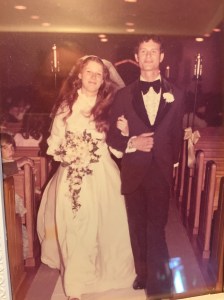
Acts 17 states this, “The God who made the world and everything in it is the Lord of heaven and earth…from one man he made every nation of men that they should inhabit the whole earth and the exact places where they should live.”
That exact place was our place in this world and we loved it. We loved our neighbors, our community, our jobs and our local church. We fell in love with marriage itself and simply could not get enough of one another. It was all a dream come true.
I then snapped a quick a photo to share with my bride. We don’t live there anymore, we’re older, we’re wiser, we have less energy, but we still love one another deeply along with our neighbors, our community, our jobs, our church and our mission together. Looking back is necessary. Realizing the long marriage commitment and trek we have been on is amazing to think about. But you know what else is amazing? Looking forward, growing more in love, still praying and maintaining the mission that our heavenly Father has given us.
Thank you 59 Traverse Road, apartment 3 for all the memories. We have moved on from you and have a new place we call home.
 September 11th, 2001, a day we will all remember here in America and around the world. I was sitting on a plane at the Baltimore/Washington airport waiting to fly to New England through New York air space when we were all asked to disembark the plane and to go home. That day, 2,996 people would lose their lives.

 Journalist and author Mignon McLaughlin once said, “A successful marriage requires falling in love many times, always with the same person.”

 So often marriage is like a mirror and we get to see our real self through the reflections of our life mate. After all, who knows you better than your spouse? Who better to reflect back to you the image you are projecting?


 Someone once shared with me these words, “I’ll respect him when he starts respecting me.” Still another said, “When she starts acting respectable, I’ll show her respect.” Really? Since when is respect conditional upon another respecting you?
 I love how author Gary Thomas weighs in on this very subject, “As our partners and their weaknesses become more familiar to us, respect often becomes harder to give. But this failure to show respect is more a sign of spiritual immaturity than it is an inevitable pathway of marriage.” He also notes, “When there is mutual respect in marriage, selflessness becomes contagious…. If you want to obsess about them [weaknesses], they’ll grow, but you won’t!”
 Marriage minefields are fields where we have buried or hidden devices (memories) just below the surface. We actually move forward in life by frequently looking backward. Most day-to-day life is not filled with new revelation but memory. Memory helps us to find our way home after work. Memory is used daily in order to live life. Life without the ability to recall even the slightest, most mundane details or important ones would be disastrous.
 Some of our memories contain lies or misbeliefs and still others are inaccurate. It was not uncommon for John and Elizabeth (not their real names) to experience knock-down, drag-out arguments. In sheer frustration late one evening, John looked at Elizabeth and said, “That’s it; I’m out of here!” Immediately, Elizabeth went silent and fell to the floor in a fetal position, where she sobbed uncontrollably. Even though John ran immediately to his wife, knelt beside her, and desperately tried to console her, it was as if he had left. Elizabeth didn’t or couldn’t hear his voice or acknowledge his presence. John later discovered that when his wife was six years old, she overheard her parents fighting. Her father’s words rang out as he screamed, “That’s it; I’m out of here!” Elizabeth never saw her father again
 Elizabeth was no longer fighting with John; she was wrestling with pain-filled memories planted in a minefield just below the surface. Was it the argument they needed to resolve, or was it Elizabeth’s past hurts that needed to be healed? From many stories like this one, I have come to believe that most relationship issues in the present have a connection to the past; therefore, what seem like marital issues are often individual issues. I am convinced that when Jesus heals our individual issues, sins, hurts, and disappointments, marriage relationship issues can also be healed. *
 Many years ago, a wiser, older, more mature couple taught us this phrase: praise in public; construct in private. By that phrase they meant to always provide a word of praise for your mate when with your family, at your work place, with your friends or in any social setting. They also encouraged us to never, ever put our mate down, shame them, humiliate them or correct them in a negative sense in public. We took this counsel to heart and have adapted it for our marriage relationship.

 Honestly, the most difficult times were when I had to enforce a boundary for my children as their father. Providing the appropriate discipline in the appropriate manner was often a challenge. Is there a difference between punishment and correction?
 Correction takes time to administer because it includes instruction toward a different and healthier future. Punishment on the other hand is normally abrupt, more about reaction and often with little thought. Proverbs 29: 15 says that the rod of correction imparts life – correction imparts life! Job 5:17 tells us, “Blessed is the man whom God corrects; so do not despise the discipline of the Almighty.”
 Perhaps lechery is a word you are not familiar with. If you look into its meaning the dictionary states, “…unrestrained or excessive indulgence of sexual desire.” I have come across this “desire” within some marriages. Usually, it is the man who relentlessly pursues an inordinate desire for sexual relations, but this is not always the case.
 Recently we took our five-year-old grandson with us for a weekend away. It wasn’t uncommon for him to say, “I’m bored” or “This is boring.” I forgot how much entertainment a young child needs. It makes me think about how boring and predictable our marriages can become. So much of life is routine oriented, repeated each and every day like that old movie, Groundhog Day starring Bill Murray.
 Recently Mary and I celebrated 44 years of marriage. Quite honestly, there have been those
