
 I would be devastated, overwhelmed and heart-broken if my daughter suffered any kind of abuse from anyone in any fashion. I would give my life to make sure that did not happen. Further, I would be equally broken and horrified if one of my sons was falsely accused of abusing another. Having raised my children with very clear values and boundaries, I would believe them if they told me abuse occurred or did not occur.
Whether there is alleged abuse or alleged accusation, I appreciate that these kinds of things, brought out and into the light, bring awareness to very destructive behaviors.
We are told that one in four girls endure or suffer from some form of abuse or molestation, which is simply horrific. But it is also true that one in five boys suffer the same. Having been a social worker and marriage and family counselor for many years, I witnessed way too much devastation in lives of youth and of adults in both females and males.

I heard stories from young women who had been molested in their family barns, a place that should have been safe for them and I heard similar stories from young men. One young man told me that his female high school English teacher while on school premises repeatedly forced him to engage in sexual intercourse. His pain over this was evident years later.
We are responsible to teach our children truth and how destructive sex can be outside God’s boundary of marriage. My wife and I shared I Timothy 5:1 and 2 with our children, “Treat younger men as brothers…and younger women as sisters, with absolute purity.” Your children’s school teachers, politicians, Hollywood or any news media will not be teaching these verses; it is your/our job to establish these boundaries and life-giving values.
Today we hand our children a smart phone to stay in touch with us. At the same time, we must realize these hand-held devices are a computer and they accesses pornography which teaches just the opposite of the values we are attempting to instill. Are you aware that Hollywood produces around 600 to 700 films per year while the pornography industry produces 13,000 films per year? Children are accessing some of the worst, most horrific sexual smut available for free on their phones each and every day.
 In these times we are hard pressed to find any moral guidance coming from Washington DC, even as governmental leaders call for morality. And Hollywood continually puts out sexually provocative films and then expects morality among its ranks. You cannot have it both ways…sorry.
So let’s take responsibility for our own lives and the lives of our family. We need to have a zero tolerance of pornography and sexually explicit movies and television.
No matter the ill in our society, God’s word has already spoken on the subject and given us the most safe, most protective and life-giving answers. It is that same book that mentions not lying, not stealing, not committing adultery, not coveting and not murdering. This is not a call to fight or resist our government, our schools or even Hollywood, but it is a call to remember who our enemy actually is.
For our struggle is not against flesh and blood, but against the rulers, against the authorities, against the powers of this dark world and against the spiritual forces of evil in the heavenly realms. (Ephesians 6: 12)
The weapons we fight with are not the weapons of the world. On the contrary, they have divine power to demolish strongholds.(I Corinthians 10: 2)
 I had this question posed from last week’s blog,

 Clinical psychologist, Anna Salter, wrote a helpful book titled, Predators: Pedophiles, Rapists and Other Sex Offenders. In that book she said, “Decades of research have demonstrated that people cannot reliably tell who is lying. Many offenders report that religious people are even easier to fool than most people.”
 In light of recent news articles about sexual abuse coming out of Pennsylvania, I thought it appropriate to consider this subject in brief.
 We don’t spot them because they blend in and we’re not naturally looking for a predator. In fact, most of us can’t even relate to such evil. With the signs above you can watch out for your children within your extended family, your neighborhood, your child’s school, sports activities and yes, your local church.
 My grandson often repeats, “Papaw, did you see me…” or, “Watch me…” You can fill in the blank with almost anything he does or desires to be noticed doing. It can be a really small thing, however he still longs to be observed. He lives for that voice of approval and praise. It’s a child thing, right
 There’s a new word in town. Have you heard of it? That word is a combination of two words: phone + snubbing = phubbing. Do you know a “phubber?” How would one know if this describes them? You can start by asking your friends. Ask your spouse or even better, ask your children. If people in your life are trying to get your attention while you’re looking down at a small hand-held screen all too frequently, you just might have a phubbing problem.
 I just want to scream, “PUT YOUR PHONE DOWN AND LISTEN TO YOUR CHILD!” You brought them into the world to teach, train, listen to, care for, play with and love. PLEASE put your device aside and interact with your child.
 Recently Mary and I, along with an auditorium full of people, attended a memorial service for a 19-year-old woman. She lost her earthly life in the recent Lancaster County, PA flooding.
 I absolutely love being a grandparent. I have been named, “Papaw.” What an honor to hold, to love and to care for these little ones. To hear the words, “Papaw’s home” is music to my ears as it reminds me of when my children were small. I wrote a former blog that called, “Grandparenting a Lost Art” and it is, but it is as well, a second chance.



 I am not totally sure why comparison is so often our human go-to mode.
 Ask God to help you hear your own thoughts of comparison and allow Him to speak truth-filled words over you rather than your own negative or pride-filled mental dialogue. I wrote another prayer tract called,
  Maggie has never had a problem with her self-image. She loves life and makes the best of every minute. She loves people and believes that they all love and accept her unconditionally. Maggie has never stared into a mirror and felt hopeless. She’s never even desired to look at herself in a mirror and make any kind of judgment. She is perfectly content with who she is, what she wears, the shape of her body, the color of her eyes, the size of her nose, and the shape of her ears. Maggie blindly trusts in her Creator. She is content to be who she is. You see, Maggie is our yellow Labrador Retriever.
 A child receives his self-image through how he perceives the adults in his life perceiving him. When I tell my daughter that she’s beautiful, she will believe that she is beautiful. You see, someone who is very important to her, someone she can trust, someone who is bigger, older, wiser and stronger told her something about herself, and she has no reason to not believe it.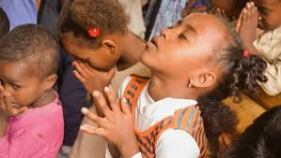
 How is this accomplished? I must correct and reward my children. It’s a part of life. However, I must differentiate that while reward and correction have to do with behavior, it is never a question that I love and accept their personhood. In their mere existence, they are important to me. I always approve of them as individuals. They can never do anything to not be my children. A verse in Colossians, chapter one, will help to explain this principle. Verse 21 tells us that we were at one time alienated from God—even in our minds, because of our evil behavior. “But now He has reconciled you by Christ’s physical body through death to present you holy in His sight, without blemish and free from accusation…”
 Steve Prokopchak