Some answers for the recently exposed leadership failures
Having walked in ministry leadership for over 50 years, I can accurately and factually say, if sin is present in the lives of leaders, it will sooner or later surface. There will eventually be some form of exposure, and a reckoning will follow.
When God’s leaders are covering up and lying about sin in their lives, His mercy will be extended, but not for a lifetime. Out of His love, He will expose it. Someone well said, “Failure is not always sin, but sin is always failure.”
Galatians 5:19-21 (TPT)
“The behavior of the self-life is obvious: Sexual immorality, lustful thoughts, pornography,
chasing after things instead of God, manipulating others, hatred of those who get in your way, senseless arguments, resentment when others are favored, temper tantrums, angry quarrels, only thinking of yourself, being in love with your own opinions, being envious of the blessings of others, murder, uncontrolled addictions, wild parties, and all other similar behavior. Haven’t I already warned you that those who use their “freedom” for these things will not inherit the kingdom realm of God!”
Failure in leadership will always relate to our personal decisions and then our actions. We’re all broken and imperfect leaders, but that does not mean we are separated from God or our accountability within the local church.
There is a HUGE difference between one exposing their own sin or failure versus our sin or failure being exposed by another. One is our own volition which will decrease collateral damage and the other becomes a stain on the body of Christ and results in unknown levels of collateral damage.
The outcome of sin or moral failure in leadership is based on two important factors: what we as an individual do about our failure, in other words, how we respond, and then what leadership does about that failure.
I’ve also heard it said, “You can stub your toe a hundred times, but you can only cut your throat once.” The way we, the church, your church chooses to handle leadership failure will either make or break that church or organization. With humility and confession, the church must respond with healing and restoration steps. However, depending on the level of authority, restoration looks different. What are some of the quantifiers?
Quantifiers include:*
• Qualitative Assessment: How serious were the sinful acts and to what degree
were people victimized by their action?
• Quantitative Assessment: How long was this sinful behavior practiced and how
many victims were involved.
• Voluntary Action: Did this person confess on their own or were they caught and forced to
confess?
• Cooperative Conduct: Did this person cooperate with investigators or were they absent
and/or uncooperative?
• Active Coverup: Did they confess their sins during the time of their perpetrated acts, or
did they seek to continuously cover them up with co-conspirators?
• Repentant Behavior: Was there sincere and open repentance from the heart or
were they more concerned about preserving their own reputation or the reputation of the organization?
• Humble Submission: Was there a willingness to submit to church discipline and
adhere to those requirements or was he/she unwilling to do so?
Once again, did this person come forward and confess their own sin? David in Psalms 36 writes, “There is no fear of God before his eyes. For in his own eyes he flatters himself too much to detect or hate his sin.” (Verses 1b, 2)
It’s all disappointing, but lest we get ahead of ourselves and point fingers, we must ask ourselves how would we like personal failure to be handled in our lives? How would we like to be treated? Would we desire grace or law? Would we desire restoration or complete failure? Forgiveness or judgment? We cannot compromise God’s word to protect personal reputation, but at the same time we must confront in truth, love, and grace because healing, restoration, and restitution are the goal.
So, it’s confrontation without partiality and confrontation for purity of the church versus an individual’s comfort or the preservation of a ministry.
Our purpose:
We work toward Colossians 1:28: “He is the one we proclaim, admonishing and teaching everyone with all wisdom, so that we may present everyone fully mature in Christ.” Also, Galatians 4:19: “My dear children, for whom I am again in the pains of childbirth until Christ is formed in you…”
And I Timothy 5:19-21: “Do not entertain an accusation against an elder unless it is brought by two or three witnesses. 20 But those elders who are sinning you are to reprove before everyone, so that the others may take warning. 21 I charge you, in the sight of God and Christ Jesus and the elect angels, to keep these instructions without partiality, and to do nothing out of favoritism.”
As well as I Corinthians 4:1-5: “This, then, is how you ought to regard us: as servants of Christ and as those entrusted with the mysteries God has revealed. 2 Now it is required that those who have been given a trust must prove faithful. 3 I care very little if I am judged by you or by any human court; indeed, I do not even judge myself. 4 My conscience is clear, but that does not make me innocent. It is the Lord who judges me. 5 Therefore judge nothing before the appointed time; wait until the Lord comes. He will bring to light what is hidden in darkness and will expose the motives of the heart. At that time each will receive their praise from God.”
A real-life example:
In giving oversight to churches we will come across failure among leaders. On one occasion, an elder confessed to his wife of his extramarital affair with another woman, then confessing to his children, along with the elder team, to God and then to his church congregation (I am not sure about the actual order of confessions.).
From there we developed a plan for healing and restoration with full repentance and turning away from sin. We described the plan he would be required to submit to. Several congregants came to us and shared, “Thank you for dealing with this forthrightly, righteously, lovingly and openly. It brings security to know our leaders and our leaders’ leaders are confronting sin and desiring to bring restoration. In our prior churches sin was always covered over and the person or leader who sinned left.”
Everywhere we look today, God is cleaning house: From IHOP to Hillsong, to the Southern Baptists, to the Catholics. He is also exposing politicians and CEO’s. This in and of itself should put the fear of God in each of us.
A side note observation of all this exposed sin
What can inadvertently happen is that churchgoers, godly people, become disillusioned and disappointed or can even grow apathetic, e.g., “If our leaders can’t hold it together, how do I stand a chance?”
Hebrews 12:2: Jesus is the author and finisher of our faith, not any leader. We must keep our eyes on Him. Jesus experienced disappointment in others. He watched the 72 walk away from following Him. I believe He processed those feelings and those thoughts with His Father. Our encouragement from this is that we must take our disappointments to God.
Hebrews 10:25 – We do not stop meeting together even though we are a very imperfect church with imperfect leaders.
Two international churches:
When I meet new leaders I take them and their spouse through some extensive questioning. I let them know we may all have skeletons in our closet, but those must be dealt with biblically and appropriately so they can come to healing. We are attempting to avoid those skeletons being exposed down the road when they not only hurt the leader but, possibly, also hurting those whom they lead.
Sin destroys our credibility and trust and if not self-exposed and brought into the light, it can also destroy the relationship. As leaders walk in unrepentant and unconfessed sin, some of the following will accompany them and their leadership:
- the misuse of power/authority
- the misuse of scripture
- the misuse of emotions
- the mishandling of resources – finances in particular
As I confronted the first leader with sexual issues, he refused to confess for multiple meetings until he finally gave in when I told him the Lord had revealed to me that something was terribly awry. He refused counsel to bring what was in the dark to the light. He turned his leadership team against me behind my back. I was unable to tell my side to his leaders and we lost that very valuable church. But more importantly, we lost the relationships we had developed over time.
The second international leader I had to confront confessed, repented, apologized, stepped down from all leadership and entered a lengthy process of healing with a hopeful restoration of ministry. Unfortunately, his confession resulted in a divorce, but I believe he himself has been spared of judgment by cooperation with steps of healing and restoration.
It is a long road back. When we fail, we don’t realize or do not always connect our actions to how many persons our sin will and does affect.
I Corinthians 9:27 – “No, I strike a blow to my body and make it my slave so that after I have preached to others, I myself will not be disqualified for the prize.” We can actually disqualify ourselves from leadership.
II Corinthians 7:9-19: “Yet now I am happy, not because you were made sorry, but because your sorrow led you to repentance. For you became sorrowful as God intended and so were not harmed in any way by us. 10 Godly sorrow brings repentance that leads to salvation and leaves no regret, but worldly sorrow brings death.”
We long for healing for the fallen, but at the same time, we must remember the ones this sin affects and harms. If we do not attack the cancer in the body of Christ, in our local church, it will spread. In many cases being exposed today, the leader’s sin, even if initially unknown, can trickle down into other leaders and affect even more innocent people.
A four-step process:
- Disassociation: I Corinthains 5:9-18: “I wrote to you in my letter not to associate with sexually immoral people—10 not at all meaning the people of this world who are immoral, or the greedy and swindlers, or idolaters. In that case you would have to leave this world.11 But now I am writing to you that you must not associate with anyone who claims to be a brother or sister[a] but is sexually immoral or greedy, an idolater or slanderer, a drunkard or swindler. Do not even eat with such people. 12 What business is it of mine to judge those outside the church? Are you not to judge those inside? 13 God will judge those outside. Expel the wicked person from among you.”
- To reach an act of forgiveness: II Corinthians 2:5-11: “If anyone has caused grief, he has not so much grieved me as he has grieved all of you to some extent—not to put it too severely. 6 The punishment inflicted on him by the majority is sufficient. 7 Now instead, you ought to forgive and comfort him, so that he will not be overwhelmed by excessive sorrow. 8 I urge you, therefore, to reaffirm your love for him.9 Another reason I wrote you was to see if you would stand the test and be obedient in everything. 10 Anyone you forgive, I also forgive. And what I have forgiven—if there was anything to forgive—I have forgiven in the sight of Christ for your sake, 11 in order that Satan might not outwit us. For we are not unaware of his schemes.”
- To be able to restore in a spirit of meekness: Galatians 6:1: “Brothers and sisters, if someone is caught in a sin, you who live by the Spirit should restore that person gently. But watch yourselves, or you also may be tempted.”
- Making restitution: Luke 19:8-9 (ESV): “And Zacchaeus stood and said to the Lord, “Behold, Lord, the half of my goods I give to the poor. And if I have defrauded anyone of anything, I restore it fourfold.” 9 And Jesus said to him, “Today salvation has come to this house, since lhe also is a son of Abraham.”
You and Me:
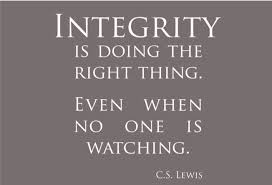
We are a part of the integrity of our local church, our family and our marriage, but more so, of Christ. When the Bible forbids something and calls it sin, it is forbidden. We are never to overlook something illegal, immoral, unscriptural or be part of a coverup of the same. We do not cover for sin or evil. “Do not touch God’s anointed…” is not a verse that justifies covering up anything. We cannot neglect Matthew 18. And you cannot rationalize with irrational people who defend their sin.
Many ask the question: do you confront publicly?
To someone who is not in a public leadership position, and they hear you and receive you as you walk through Matthew 18, no. To leadership individual who are involved in chronic, ongoing sin and who does not confess, but cover up, yes. Our example? Galatians 2:11-13: Paul is confronting Peter. “Now when Peter had come to Antioch, I withstood him to his face, because he was to be blamed; 12 for before certain men came from James, he would eat with the Gentiles; but when they came, he withdrew and separated himself, fearing [f]those who were of the circumcision. 13 And the rest of the Jews also played the hypocrite with him, so that even Barnabas was carried away with their hypocrisy.”
At the same time realize your own potential for failure.
I Corinthians 10:13: 13” The temptations in your life are no different from what others experience. And God is faithful. He will not allow the temptation to be more than you can stand. When you are tempted, he will show you a way out so that you can endure.”
Ways to walk in health, integrity and accountability:
- Make a personal commitment to God’s word and His standards for personal boundaries. The word of God, containing the boundaries of God, has been given for our protection.
Psalm 119:9 – “How can a young person stay pure? By obeying your word.”
Write down your personal ministry boundaries! For example: not traveling alone; not counseling the opposite sex alone, etc.
- Maintain your marriage vows and commitment.
What are your marriage boundaries? Write them down in agreement with your spouse.
Proverbs 5:18-19: “Let your wife be a fountain of blessing for you. Rejoice in the wife of your youth. 19 She is a loving deer, a graceful doe. Let her breasts satisfy you always.
May you always be captivated by her love.”
Grass is greener when you water it and fertilize it. Water your marriage, grow it, sow into it actively. Lust is not physical attraction – that’s humanness. Lust is desire to take what is not yours. Redirect your attraction to your life mate.
- Be accountable and self-report – everyone in authority is under authority. Every one of us needs accountability.
Everyone in the medical field is held accountable by self-reporting and constant computer charting. When a medical professional makes a medicine mistake, they are required to report it by placing it into their charting logs. If they fail to do this and their mistake is discovered, they will surely be fired from their job. However, if they are completely honest about their mistake and report it properly, they most likely will keep their job with a warning. This is a process of taking a wrongdoing from the dark and successfully, forthrightly, and honestly bringing it into the light.
- Monitor your thoughts: Beliefs –> Thoughts –> Feelings –> Actions –> Habits
“Temptation comes from our own desires, which entice us and drag us away. 15 These desires give birth to sinful actions. And when sin is allowed to grow, it gives birth to death.” (James 1:14-15)
As we monitor our thoughts and then backtrack to our beliefs, we’ll discover either misbeliefs or God’s beliefs. It is the ongoing process of Romans 12: 2 – “Do not conform to the pattern of this world but be transformed by the renewing of your mind. Then you will be able to test and approve what God’s will is—his good, pleasing and perfect will.”
David said in Psalms 101: 3 – “I will not look with approval on anything that is vile.
I hate what faithless people do; I will have no part in it.”
- Keep watch and magnify the consequences. Know what tempts you. Ask yourself: Is it worth it? What do I stand to lose? What is the possible collateral damage?
“The eye is the lamp of the body. If your eyes are healthy,[a] your whole body will be full of light. 23 But if your eyes are unhealthy,[b] your whole body will be full of darkness. If then the light within you is darkness, how great is that darkness!” (Matthew 6:22-23)
12 “Blessed is the one who perseveres under trial because, having stood the test, that person will receive the crown of life that the Lord has promised to those who love him.” (James 1:12)
Temptation to sin is always shortsighted and not thought through. To be unfaithful to the Lord, to your marriage and family, you must make multiple wrong decisions to pursue something wrong or sinful – multiple. We each have ample opportunity to stop, listen to that still small voice and repent, cut off our thoughts and our actions so that we can return to God’s truth and the freedom His truth provides.
*Thank you to the PRT team and Mark Pfeifer for these qualifications.




















 Steve Prokopchak