Challenge, Encouragement, Healing, In the news, Issues of the Day, Leadership, Men, Training, Women

Navigating Leadership Disappointment and Failure

Some answers for the recently exposed leadership failures

Having walked in ministry leadership for over 50 years, I can accurately and factually say, if sin is present in the lives of leaders, it will sooner or later surface. There will eventually be some form of exposure, and a reckoning will follow. 

When God’s leaders are covering up and lying about sin in their lives, His mercy will be extended, but not for a lifetime. Out of His love, He will expose it. Someone well said, “Failure is not always sin, but sin is always failure.”

Galatians 5:19-21 (TPT)

 “The behavior of the self-life is obvious: Sexual immorality, lustful thoughts, pornography,
 chasing after things instead of God, manipulating others, hatred of those who get in your way, senseless arguments, resentment when others are favored, temper tantrums, angry quarrels, only thinking of yourself, being in love with your own opinions, being envious of the blessings of others, murder, uncontrolled addictions, wild parties, and all other similar behavior. Haven’t I already warned you that those who use their “freedom” for these things will not inherit the kingdom realm of God!”

Failure in leadership will always relate to our personal decisions and then our actions. We’re all broken and imperfect leaders, but that does not mean we are separated from God or our accountability within the local church. 

There is a HUGE difference between one exposing their own sin or failure versus our sin or failure being exposed by another. One is our own volition which will decrease collateral damage and the other becomes a stain on the body of Christ and results in unknown levels of collateral damage.

The outcome of sin or moral failure in leadership is based on two important factors: what we as an individual do about our failure, in other words, how we respond, and then what leadership does about that failure.

I’ve also heard it said, “You can stub your toe a hundred times, but you can only cut your throat once.” The way we, the church, your church chooses to handle leadership failure will either make or break that church or organization. With humility and confession, the church must respond with healing and restoration steps. However, depending on the level of authority, restoration looks different. What are some of the quantifiers?

Quantifiers include:*

• Qualitative Assessment: How serious were the sinful acts and to what degree

were people victimized by their action?

• Quantitative Assessment: How long was this sinful behavior practiced and how

many victims were involved.

• Voluntary Action: Did this person confess on their own or were they caught and forced to

confess?

• Cooperative Conduct: Did this person cooperate with investigators or were they absent

and/or uncooperative?

• Active Coverup: Did they confess their sins during the time of their perpetrated acts, or

did they seek to continuously cover them up with co-conspirators?

• Repentant Behavior: Was there sincere and open repentance from the heart or

were they more concerned about preserving their own reputation or the reputation of the organization?

• Humble Submission: Was there a willingness to submit to church discipline and

adhere to those requirements or was he/she unwilling to do so?

Once again, did this person come forward and confess their own sin? David in Psalms 36 writes, “There is no fear of God before his eyes. For in his own eyes he flatters himself too much to detect or hate his sin.” (Verses 1b, 2)

It’s all disappointing, but lest we get ahead of ourselves and point fingers, we must ask ourselves how would we like personal failure to be handled in our lives? How would we like to be treated? Would we desire grace or law? Would we desire restoration or complete failure? Forgiveness or judgment? We cannot compromise God’s word to protect personal reputation, but at the same time we must confront in truth, love, and grace because healing, restoration, and restitution are the goal.

So, it’s confrontation without partiality and confrontation for purity of the church versus an individual’s comfort or the preservation of a ministry.

Our purpose:

We work toward Colossians 1:28: “He is the one we proclaim, admonishing and teaching everyone with all wisdom, so that we may present everyone fully mature in Christ.” Also, Galatians 4:19: “My dear children, for whom I am again in the pains of childbirth until Christ is formed in you…” 

And I Timothy 5:19-21: “Do not entertain an accusation against an elder unless it is brought by two or three witnesses. 20 But those elders who are sinning you are to reprove before everyone, so that the others may take warning. 21 I charge you, in the sight of God and Christ Jesus and the elect angels, to keep these instructions without partiality, and to do nothing out of favoritism.”

As well as I Corinthians 4:1-5: “This, then, is how you ought to regard us: as servants of Christ and as those entrusted with the mysteries God has revealed. Now it is required that those who have been given a trust must prove faithful. I care very little if I am judged by you or by any human court; indeed, I do not even judge myself. My conscience is clear, but that does not make me innocent. It is the Lord who judges me. Therefore judge nothing before the appointed time; wait until the Lord comes. He will bring to light what is hidden in darkness and will expose the motives of the heart. At that time each will receive their praise from God.”

A real-life example:

In giving oversight to churches we will come across failure among leaders. On one occasion, an elder confessed to his wife of his extramarital affair with another woman, then confessing to his children, along with the elder team, to God and then to his church congregation (I am not sure about the actual order of confessions.). 

From there we developed a plan for healing and restoration with full repentance and turning away from sin. We described the plan he would be required to submit to. Several congregants came to us and shared, “Thank you for dealing with this forthrightly, righteously, lovingly and openly. It brings security to know our leaders and our leaders’ leaders are confronting sin and desiring to bring restoration. In our prior churches sin was always covered over and the person or leader who sinned left.”

Everywhere we look today, God is cleaning house: From IHOP to Hillsong, to the Southern Baptists, to the Catholics. He is also exposing politicians and CEO’s. This in and of itself should put the fear of God in each of us. 

A side note observation of all this exposed sin

What can inadvertently happen is that churchgoers, godly people, become disillusioned and disappointed or can even grow apathetic, e.g., “If our leaders can’t hold it together, how do I stand a chance?”

Hebrews 12:2: Jesus is the author and finisher of our faith, not any leader. We must keep our eyes on Him. Jesus experienced disappointment in others. He watched the 72 walk away from following Him. I believe He processed those feelings and those thoughts with His Father. Our encouragement from this is that we must take our disappointments to God. 

Hebrews 10:25 – We do not stop meeting together even though we are a very imperfect church with imperfect leaders. 

Two international churches:

When I meet new leaders I take them and their spouse through some extensive questioning. I let them know we may all have skeletons in our closet, but those must be dealt with biblically and appropriately so they can come to healing. We are attempting to avoid those skeletons being exposed down the road when they not only hurt the leader but, possibly, also hurting those whom they lead. 

Sin destroys our credibility and trust and if not self-exposed and brought into the light, it can also destroy the relationship. As leaders walk in unrepentant and unconfessed sin, some of the following will accompany them and their leadership: 

  • the misuse of power/authority
  • the misuse of scripture
  • the misuse of emotions
  • the mishandling of resources – finances in particular

As I confronted the first leader with sexual issues, he refused to confess for multiple meetings until he finally gave in when I told him the Lord had revealed to me that something was terribly awry. He refused counsel to bring what was in the dark to the light. He turned his leadership team against me behind my back. I was unable to tell my side to his leaders and we lost that very valuable church. But more importantly, we lost the relationships we had developed over time.

The second international leader I had to confront confessed, repented, apologized, stepped down from all leadership and entered a lengthy process of healing with a hopeful restoration of ministry. Unfortunately, his confession resulted in a divorce, but I believe he himself has been spared of judgment by cooperation with steps of healing and restoration.  

It is a long road back. When we fail, we don’t realize or do not always connect our actions to how many persons our sin will and does affect. 

I Corinthians 9:27 – “No, I strike a blow to my body and make it my slave so that after I have preached to others, I myself will not be disqualified for the prize.” We can actually disqualify ourselves from leadership.

II Corinthians 7:9-19: “Yet now I am happy, not because you were made sorry, but because your sorrow led you to repentance. For you became sorrowful as God intended and so were not harmed in any way by us. 10 Godly sorrow brings repentance that leads to salvation and leaves no regret, but worldly sorrow brings death.” 

We long for healing for the fallen, but at the same time, we must remember the ones this sin affects and harms. If we do not attack the cancer in the body of Christ, in our local church, it will spread. In many cases being exposed today, the leader’s sin, even if initially unknown, can trickle down into other leaders and affect even more innocent people.

A four-step process:

  1. Disassociation: I Corinthains 5:9-18: “I wrote to you in my letter not to associate with sexually immoral people—10 not at all meaning the people of this world who are immoral, or the greedy and swindlers, or idolaters. In that case you would have to leave this world.11 But now I am writing to you that you must not associate with anyone who claims to be a brother or sister[a] but is sexually immoral or greedy, an idolater or slanderer, a drunkard or swindler. Do not even eat with such people. 12 What business is it of mine to judge those outside the church? Are you not to judge those inside? 13 God will judge those outside. Expel the wicked person from among you.”
  2. To reach an act of forgiveness: II Corinthians 2:5-11: “If anyone has caused grief, he has not so much grieved me as he has grieved all of you to some extent—not to put it too severely. The punishment inflicted on him by the majority is sufficient. Now instead, you ought to forgive and comfort him, so that he will not be overwhelmed by excessive sorrow. I urge you, therefore, to reaffirm your love for him.Another reason I wrote you was to see if you would stand the test and be obedient in everything. 10 Anyone you forgive, I also forgive. And what I have forgiven—if there was anything to forgive—I have forgiven in the sight of Christ for your sake, 11 in order that Satan might not outwit us. For we are not unaware of his schemes.”
  3. To be able to restore in a spirit of meekness: Galatians 6:1: “Brothers and sisters, if someone is caught in a sin, you who live by the Spirit should restore that person gently. But watch yourselves, or you also may be tempted.”
  4. Making restitution: Luke 19:8-9 (ESV): And Zacchaeus stood and said to the Lord, “Behold, Lord, the half of my goods I give to the poor. And if I have defrauded anyone of anything, I restore it fourfold.” And Jesus said to him, “Today salvation has come to this house, since lhe also is a son of Abraham.”

You and Me:

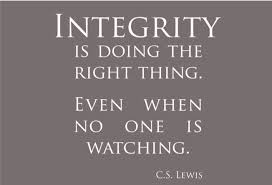
We are a part of the integrity of our local church, our family and our marriage, but more so, of Christ. When the Bible forbids something and calls it sin, it is forbidden. We are never to overlook something illegal, immoral, unscriptural or be part of a coverup of the same. We do not cover for sin or evil. “Do not touch God’s anointed…” is not a verse that justifies covering up anything. We cannot neglect Matthew 18.  And you cannot rationalize with irrational people who defend their sin. 

Many ask the question: do you confront publicly?

To someone who is not in a public leadership position, and they hear you and receive you as you walk through Matthew 18, no. To leadership individual who are involved in chronic, ongoing sin and who does not confess, but cover up, yes. Our example? Galatians 2:11-13: Paul is confronting Peter. “Now when Peter had come to Antioch, I withstood him to his face, because he was to be blamed; 12 for before certain men came from James, he would eat with the Gentiles; but when they came, he withdrew and separated himself, fearing [f]those who were of the circumcision. 13 And the rest of the Jews also played the hypocrite with him, so that even Barnabas was carried away with their hypocrisy.”

At the same time realize your own potential for failure. 

I Corinthians 10:13: 13” The temptations in your life are no different from what others experience. And God is faithful. He will not allow the temptation to be more than you can stand. When you are tempted, he will show you a way out so that you can endure.”

Ways to walk in health, integrity and accountability:

  1. Make a personal commitment to God’s word and His standards for personal boundaries. The word of God, containing the boundaries of God, has been given for our protection. 

Psalm 119:9 – “How can a young person stay pure? By obeying your word.”

Write down your personal ministry boundaries! For example: not traveling alone; not counseling the opposite sex alone, etc.

  • Maintain your marriage vows and commitment. 

What are your marriage boundaries? Write them down in agreement with your spouse.

Proverbs 5:18-19: “Let your wife be a fountain of blessing for you. Rejoice in the wife of your youth. 19 She is a loving deer, a graceful doe. Let her breasts satisfy you always.
May you always be captivated by her love.”

Grass is greener when you water it and fertilize it. Water your marriage, grow it, sow into it actively. Lust is not physical attraction – that’s humanness. Lust is desire to take what is not yours. Redirect your attraction to your life mate.

  • Be accountable and self-report – everyone in authority is under authority. Every one of us needs accountability. 

Everyone in the medical field is held accountable by self-reporting and constant computer charting. When a medical professional makes a medicine mistake, they are required to report it by placing it into their charting logs. If they fail to do this and their mistake is discovered, they will surely be fired from their job. However, if they are completely honest about their mistake and report it properly, they most likely will keep their job with a warning. This is a process of taking a wrongdoing from the dark and successfully, forthrightly, and honestly bringing it into the light.

  • Monitor your thoughts:  Beliefs –> Thoughts –> Feelings –> Actions –> Habits  

Temptation comes from our own desires, which entice us and drag us away. 15 These desires give birth to sinful actions. And when sin is allowed to grow, it gives birth to death.” (James 1:14-15)

As we monitor our thoughts and then backtrack to our beliefs, we’ll discover either misbeliefs or God’s beliefs. It is the ongoing process of Romans 12: 2 – “Do not conform to the pattern of this world but be transformed by the renewing of your mind. Then you will be able to test and approve what God’s will is—his good, pleasing and perfect will.”

David said in Psalms 101: 3 – “I will not look with approval on anything that is vile.

I hate what faithless people do; I will have no part in it.”

  • Keep watch and magnify the consequences. Know what tempts you. Ask yourself: Is it worth it? What do I stand to lose? What is the possible collateral damage?

“The eye is the lamp of the body. If your eyes are healthy,[a] your whole body will be full of light. 23 But if your eyes are unhealthy,[b] your whole body will be full of darkness. If then the light within you is darkness, how great is that darkness!” (Matthew 6:22-23)

12 “Blessed is the one who perseveres under trial because, having stood the test, that person will receive the crown of life that the Lord has promised to those who love him.” (James 1:12)

Temptation to sin is always shortsighted and not thought through. To be unfaithful to the Lord, to your marriage and family, you must make multiple wrong decisions to pursue something wrong or sinful – multiple. We each have ample opportunity to stop, listen to that still small voice and repent, cut off our thoughts and our actions so that we can return to God’s truth and the freedom His truth provides.

*Thank you to the PRT team and Mark Pfeifer for these qualifications.

Standard
Challenge, Encouragement, Healing, Issues of the Day, Leadership, Training

It Can be Painful to Become Fruitful

I have grown apple, pear and peach trees for years and enjoyed the fruit they bear. It was a constant challenge however, growing fruit from those trees. There were diseases that attacked them. Ants loved those trees, as did multiple other insects. They had to be sprayed regularly and pruned annually. Of course, bees were necessary to pollinate them; rain, sun, and regular feeding to grow them. It’s any wonder with all the work there was any fruit at all. 

I had one other hazard to look out for with my fruit trees in particular–our yellow labrador retriever, Maggie. She loved picking the low hanging fruit. When it was green, she had endless fun playing with those “balls.” When it was ripe, she grabbed her daily share to lay down on our picnic bench and devour them. 

Without all the work there was no fruit, or at best, low quality fruit. But work should yield good fruit, right? The concept of growing fruit is found in the Bible. Jesus spoke about it and He verified that His Father was a fruit grower as well. In John chapter 15 Jesus shared that He cuts off branches which no longer produce fruit. No fruit can be born without a connection to the tree. Jesus taught that He is the vine and we are the branches. Apart from Jesus, we cannot produce fruit. 

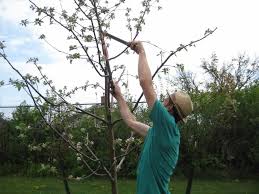
Further, He taught us about pruning or cutting the tree back so it can give more of its energy into growing fruit. It took me years to develop the concept of a proper pruning of a fruit tree. I can still recall one older gentleman who said, “After you cut the tree back, return to it and prune it again.” The tree looks pretty bare and hopeless to produce anything. 

When Paul the Apostle was writing to the Galatian church he mentioned “fruit of the Spirit” and then listed them as love, joy, peace, patience, kindness, goodness, faithfulness, gentleness, and self-control. While God’s pruning of us as His branches is not painless, it serves a very clear purpose: producing fruit in our lives and ridding us of “the sinful nature desires” that are “contrary to the Spirit.” Like pruning a fruit tree to produce larger, sweeter, and more inviting fruit, our heavenly Father is pruning us so we can produce good and attractive fruit from our lives.

Your heavenly Father is a gentle vine dresser, but purposeful. He knows exactly where to operate, how deep to cut, and how much to sever. Grant Him permission to cut off the unfruitful desires of the flesh so He can grow His fruit of the Spirit in your life, “Since we live by the Spirit, let us keep in step with the Spirit.” (See Galatians 5:16-26.)

Standard
Challenge, Encouragement, Issues of the Day, Prayer

Rituals Can Be Healthy

I love coffee. Every morning I brew three cups of the darkest roast I can find and I drink every drop. It’s warm, it’s familiar, it’s representing a new day as a part of my morning ritual. 

My Bible is next. I love God’s word as my first meal. It’s nourishing, it’s encouraging, it’s familiar, it’s life-giving, and it’s all truth. 

When God speaks to me through His word, I find it satisfying, reassuring, life-changing, and rich. There is always life application from His word and something to meditate on for the day. 

The next part is prayer. I have two prayer cards. One is filled with daily requests for healing, protection, or restoration attached to a name; one of those important people in my life. The second card is divided into seven days, and each day represents a different prayer need. 

The final part of my morning ritual is prayer with my wife. We cover our children and our grandchildren, those who are struggling with illness, the issues of our week and, of course, one another. 

Only after these important steps will I move to the breakfast table. 

There was a commercial that went something like this: “The best part of waking up is Folgers in your cup.” While I like coffee and I will not apologize for that, it is not the best part of my morning. The best part is God’s word and prayer. I have my favorite conversations of the day with my King and I trust He with me as I take time to listen for his voice. 

The word of the Lord is flawless – Proverbs 30:5

We can live according to His word – Psalm 119:9

We can hide His word in our hearts – Psalm 119:11

His words are sweet – Psalm 119:103

It is a lamp unto our feet – Psalm 119:105

All His words are true – Psalm 119:160

His words will never pass away – Matthew 24:35

In His words are eternal life – John 6:68

The word is living and it is sharp – Hebrews 4:12

Perhaps your morning routines are different from mine and that is certainly ok. But there is a ritual that is life itself: God’s word and prayer. Engage in them today and it will be the best part of waking up!

Standard
Children, Encouragement, History, In the news, Issues of the Day, Just for fun, Parents

It’s Christmas!

Christmas is that wonderful time of year when we celebrate the birth of Christ with our families and the world. This season is celebrated around the world in different forms and fashions, but the holiday is dedicated to remembering and rejoicing in the birth of our Savior and Redeemer, Christ.

Here are some fun facts about Christmas gathered for your family enjoyment:

  • The tallest Christmas tree ever displayed was in Seattle, Washington. It measured 221 feet tall.  
  • The top six Christmas tree producing states are Oregon, North Carolina, Pennsylvania, Michigan, Washington and Wisconsin.
  • Buying all the gifts from the “12 Days of Christmas” song would cost you a ton of money. The most expensive being “Swans a Swimming.”
  • When the candy cane was created in Germany, it was made into a “J” for Jesus. The red                 stripes symbolize His blood and the white His purity. 
  • It is a tradition in Japan to eat KFC for Christmas. Orders must be placed two months in advance.
  • 1 in 3 men wait until Christmas Eve to do their shopping.
  • Christmas trees usually grow for close to 15 years before they can be sold. 
  • Bing Crosby’s version of “White Christmas” is the highest-selling single of all time.
  • Christmas lights were so expensive that they used to be rented rather than sold. An electrically lit tree was a status symbol in the early 1900’s.
  • The first Salvation Army collection kettle took place in San Francisco’s Oakland Ferry at the foot of Market St. It was a large crab pot with a sign that read “Keep the Pot Boiling.”  
  • In 2012 there were more than 15,000 holiday decorating injuries during November and December. The most common being falls, 34% of all injuries.  
  • The word “Merry” in Merry Christmas was not always accepted because being merry used to signify slight intemperance.  
  • The Charles W. Howard Santa Claus School in Midland, MI hosts 130 Santas each year where they gather and learn about the history of St. Nick, popular toys and Santa etiquette.  
  • In 1980, the highest selling Christmas toy was a Rubik’s cube for $1.99. It now retails for $10.
  • The abbreviation X in X-Mas is not an abbreviation. It stands for “Chi,” meaning Christ in Greek.  
  • The reason we give presents during Christmas is to symbolize the gifts given to Jesus by the three wise men.

There you have a few facts about Christmas, some rather strange. I pray that your Christmas season is full of fun, family, love, and of course CHRIST!

For a child is born to us,
    a son is given to us.
The government will rest on his shoulders.
    And he will be called:
Wonderful Counselor,
[a] Mighty God,
    Everlasting Father, Prince of Peace.
His government and its peace
    will never end.
He will rule with fairness and justice from the throne of his ancestor David
    for all eternity.
The passionate commitment of the Lord of Heaven’s Armies
    will make this happen! (Isaiah 9:6, 7 NLT)

Standard
Challenge, Encouragement, Issues of the Day, Leadership, Men, Parents, Prayer, Training, Women

Finding Your Happy Pace

It is said that not everyone is a goal setter. There are those who live day-by-day; what will come will come and somehow get away with it. They specialize in not having a plan, being primarily spontaneous, and perhaps generally lacking or maybe even avoiding order. 

Then there are those who not only have a plan and goals, but they also have a list–a daily list. They love their list and especially enjoy crossing off those tasks completed. They feel productive and useful. And when they complete their list, only then can they rest. 

I personally fall into the latter group. I have lists for daily jobs, blogs I want to write, work I want to accomplish, and sermon messages I want to share. Checking off an accomplishment from my list gives me certain satisfaction. At the same time, I feel like I’m not missing things I should not miss. My lists are a reminder. While I am not driven by them, they help me find my pace.

If I don’t get through my list, then the items simply go to another day–no worries. I do not fret over my list if not every line item is accomplished. But I have a secret that I am going to let you in on. 

I start every day with God. I do not begin any list before I spend time with my Friend, my Savior, my Boss, and my Pace Setter. I want my list to honor Him first. And I want Him to be honored before my list. My priority is to “seek first the kingdom of God” and then knowing He will help me accomplish my list. 

The only way to really know someone is to spend time with them. The only way to have true direction is to hear your Father’s voice. He’s waiting to spend time with you, to speak to you, to love you and to share His thoughts so that your daily pace is directed by Him. Ecclesiastes 3:1 reminds us that there is a time for everything.

In their hearts humans plan their course, but the Lord establishes their steps. (Proverbs 16:9)

Standard
Challenge, Issues of the Day, Marriage, Men, Parents, Premarital, Singles, Training, Women

From the First Date to Marriage!

Imagine I tell you that I met the woman of my dreams and on our first date we spent a full day together. We went for coffee, and we talked as we strolled the park. Then we found the perfect lunch spot along the canal front. By late afternoon we had talked constantly and are now holding hands. As a result, over dinner we decided to get married, tie the knot, get hitched!

What are you thinking of me and my first date? What is your immediate reaction, “You’re crazy?” To which I respond, “But you weren’t there; you have no idea of the love we feel.”

Obviously human bonding, relationships toward marriage, cannot occur from one date. It takes time to build a relationship that leads to a lifetime marital commitment.

Now suppose I tell you that I have been dating a young lady for five and a half years without any engagement or promise to marry. What are you thinking? I know I would be wondering if there is any reality for the future of this couple or are they wasting their precious time?

Just because something feels good does not mean it is good. That’s like gambling or playing the lottery. It takes time to build a sustainable relationship toward marriage, in the workplace with a boss or with your neighbor. How do you know that relationship has been built? Trust is at its core.

Without trust, relationships will always feel suspect, tentative or iffy. I cannot say how long it takes to build a trustworthy relationship, but I do know it is longer than a one-day date. We must discover core values, similar or complementary missions and dreams. 

If you’re wondering about your future and marriage, we have a resource to recommend to you. It will walk you through multiple questions to consider, a budget, co-mission, and much, much more. You can find that resource here.

Standard
Challenge, Healing, Just for fun, Marriage, Men, Parents, Postmarital, Premarital, Women

Bringing Laughter into Your Marriage

My wife and I love to laugh. We’ll catch Funniest Home Videos whenever we can. I take the time to show her funny YouTube videos or share memes that cause a chuckle. Why? 

A cheerful heart is good medicine,
    but a crushed spirit dries up the bones. (Proverbs 17:22)

Laughter brings joy to a marriage. It breaks down tension and relaxes the atmosphere. Laughter is medicinal to the soul, the spirit and the body. Laughter is physically, emotionally, and spiritually good for your marriage. 

Have you ever asked your spouse these questions? “What made you laugh today?” Or how about, “What’s the funniest memory you have in our marriage?” Bringing laughter into your marriage can help move us from a stale place, an angry place or a disappointed place to a place of smiles and positive emotions. 

Mary and I recently recalled one of the funniest times in our marriage. It was years ago when our kids were teenagers and we had just dropped off our daughter for a church activity. We noticed that all the lights were on at the brand-new Burger King in our town. There was traffic and people were inside eating. We decided on a hamburger dinner. It was strange though…

As we entered, the new manager offered us champaign. We made our way to the line to order and the kids behind the counter offered anything we wanted, any menu item for FREE. I said, “Free, are you sure?” “Yes” said the attendant. She then countered, “Order all you want, even dessert; it’s all free!” I immediately leaned over and whispered in my wife’s ear, “We need to call our boys; they’ll show them how to do free.”

Mary went for our drinks while I grabbed a table. Within minutes she came running to find me. Looking straight at me with this horrid face of doom and speaking rapidly, but very quietly, said, “Steve, every person here is a parent of a kid who’s going to work here. It’s free because they are giving them opportunity to serve in real time to their families.” And then she added, “We have got to get out of here before someone asks us which of our kids will be working here!”

We gobbled our food down and hightailed it out of there. We found ourselves laughing for the next thirty minutes. We even woke up our sleeping daughter that night as we lay in our bed laughing out loud.

Laughing together will bring you closer; you’ll touch more and talk more. A conversation full of laughter is more intimate and will bring down your guard, creating an atmosphere of more openness.

Laughter– it’ll do your marriage good!

Our mouths were filled with laughter,
    our tongues with songs of joy.
Then it was said among the nations,
    “The Lord has done great things for them.” (Psalm 126:2)

Standard
Challenge, Encouragement, In the news, Issues of the Day, Leadership, Politics, Training

Social Media Dissension and How You and I Are Part of the Problem

If you are like me, you’re tempted to cast your vote toward the negative side when there is a social media post about someone you dislike, someone who pushes the values you do not stand for or someone who does not speak for you. And yet, their platform might be larger than yours or mine. It’s a challenge when every known opinion is exposed today for all to read. The sad fact is though, it may not be the truth or the whole truth. Unfortunately, we can get caught up in reacting to a post that may or may not be accurate. (It is well known now that even “fact checkers” can stand with one side.)

You cast your opinion for all to read on social media. You gain a few likes. It comes and goes with each new day, but your words remain on that page. Now others see how to identify you or how to characterize you. It’s a sad reality of social media and the freedom we have in expressing our opinion on any matter, often of which we have no power or purpose to change.

When you and I express a strong opinion to which some of your personal relationships disagree with, you have now effectively isolated yourself and/or placed an enmity between you and your friend. At the very least, an antagonism or an animosity to avoid. Even writing this blog forces me to face that reality.

You have the freedom to speak against anyone including the president of the United States, but is it the right thing to do? You have the freedom (in this nation) to express your opinion about any authority you disagree with. 

Along those lines, I desire to provide for you some scriptures to reflect upon, to consider before you write that next post. For the believer, there is a different standard than the world. For the Christ follower, our speech is to be reflective of our Lord and His love. When we forget this, we easily entertain the flesh and what feels right rather than what is right. 

First, always maintain a position of honor toward authority (words in bold for emphasis of the point):

I urge, then, first of all, that petitions, prayers, intercession and thanksgiving be made for all people— for kings and all those in authority, that we may live peaceful and quiet lives in all godliness and holiness. This is good, and pleases God our Savior, who wants all people to be saved and to come to a knowledge of the truth. (I Timothy 2:1-4)

Remind the people to be subject to rulers and authorities, to be obedient, to be ready to do whatever is good, to slander no one, to be peaceable and considerate, and always to be gentle toward everyoneBut avoid foolish controversies and genealogies and arguments and quarrels about the law, because these are unprofitable and useless. 10 Warn a divisive person once, and then warn them a second time. After that, have nothing to do with them. (Titus 3:1-2, 9-10)

Let everyone be subject to the governing authorities, for there is no authority except that which God has established. The authorities that exist have been established by God. Therefore, it is necessary to submit to the authorities, not only because of possible punishment but also as a matter of conscience. 13 Let us behave decently, as in the daytime, not in carousing and drunkenness, not in sexual immorality and debauchery, not in dissension and jealousy.(Romans 13:1,5,13)

  • What is dissension? The Greek word translated as “dissensions” in the New Testament is dichostasia, which literally means “standing apart” or “division.”
  • Dissensions are presented as a negative force that disrupts relationships, creates factions, and hinders the progress of God’s work.
  • Dissension is purposefully creating division and disagreement among relational connections and scripturally determined to be ungodly or sinful.

Dissension in the scriptures:

29 Do not let any unwholesome talk come out of your mouths, but only what is helpful for building others up according to their needs, that it may benefit those who listen. 30 And do not grieve the Holy Spirit of God, with whom you were sealed for the day of redemption. 31 Get rid of all bitterness, rage and anger, brawling and slander, along with every form of malice. 32 Be kind and compassionate to one another, forgiving each other, just as in Christ God forgave you.(Ephesians 4:29-32)

14 For the entire law is fulfilled in keeping this one command: “Love your neighbor as yourself.” 15 If you bite and devour each other, watch out or you will be destroyed by each other.

16 So I say, walk by the Spirit, and you will not gratify the desires of the flesh.17 For the flesh desires what is contrary to the Spirit, and the Spirit what is contrary to the flesh. They are in conflict with each other, so that you are not to do whatever you want. 18 But if you are led by the Spirit, you are not under the law.

19 The acts of the flesh are obvious: sexual immorality, impurity and debauchery; 20 idolatry and witchcraft; hatred, discord, jealousy, fits of rage, selfish ambition, dissensions, factions 21 and envy; drunkenness, orgies, and the like. I warn you, as I did before, that those who live like this will not inherit the kingdom of God.

22 But the fruit of the Spirit is love, joy, peace, forbearance, kindness, goodness, faithfulness, 23 gentleness and self-control. Against such things there is no law. (Galatians 5:14-23)

Do not be deceived: God cannot be mocked. A man reaps what he sows.Whoever sows to please their flesh, from the flesh will reap destruction; whoever sows to please the Spirit, from the Spirit will reap eternal life. Let us not become weary in doing good, for at the proper time we will reap a harvest if we do not give up. 10 Therefore, as we have opportunity, let us do good to all people, especially to those who belong to the family of believers. (Galatians 6:7-10)

I learned a long time ago there are three sides to every story of which our media today nor social media present in any unbiased fashion. Those three sides are: your side; the other side and the truth. Unfortuanately, we are inundated with one-sided information today. 

Remember: In a lawsuit the first to speak seems right, until someone comes forward and cross-examines. (Proverbs 18:17)

Thank you for hearing God’s heart, identifying with his word and truly desiring to honor His word with your speech. May all we say, may all we write and may all the ways we influence others bring glory to God!

Standard
Challenge, Children, Encouragement, Healing, Issues of the Day, Leadership, Marriage, Men, Parents, Postmarital, Women

Does Going Through a Rough Patch in Our Marriage Disqualify Us from Ministry?

Every marriage has it challenges and some more than others. Does that disqualify us from ministry in our local church or elsewhere? The answer? Yes and no.

The first step is assessment. How long have we had this struggle? Is it a repeated struggle? Have we sought counsel for this particular issue? Do we avoid finding solutions? Are we actively trying to find solutions? Are we being stubborn and refusing personal change? Are either one of us in active sin? Are we blaming our spouse solely for the struggle and not taking any personal responsibility? 

The answers to these questions can help us determine whether we should be involved in ministry during this season of our relationship.

We recently experienced a couple sharing with us they feel disqualified for entering a couples’ ministry at this time because they are attempting to work through some of their own marriage issues. I asked them if they ever struggle raising their children or have they made huge mistakes in parenting. They said, “yes.” I then asked them if they should stop parenting or perhaps consider adopting out their children. As ridiculous as that sounds, sometimes it’s just as ridiculous to think disqualification from ministry over aggressively pursuing marital healing.

You must know if you can minister to others while experiencing conflict yourself, but neither does the conflict always disqualify you from serving others. It is out of our own pain sometimes that we learn to help others. And healed people can bring healing to many!

The key is, after assessment, chase healing. Give it everything you have and pursue growth in your marriage and in your individual lives. As we heal individually, our marriage will also experience healing. There is no perfect marriage, but we serve a perfect Savior who possesses all the answers we need for our daily life challenges!

Standard
Challenge, Children, Encouragement, Issues of the Day, Marriage, Men, Parents, Singles, Training, Women

Do You Punish Your Children or Do You Correct Them?

Honestly, one of the most difficult times while raising children was when I had to enforce a boundary as their father. Providing the appropriate discipline in the appropriate manner was often a challenge. You see, children have this uncanny ability to bring the worst out of you as the parent. At my worst, I might have over-corrected or when angry dished out punishment rather than correction. Is there a difference? Yes, there is.  (And by the way, seeing your “worst” is not such a bad thing.) 

Punishment has to do with me preserving my right to be angry with my child and keeping my posture as the one in charge. It says that my child must pay for what he or she did wrong. Punishment is often done out of anger lacking any training toward change, put simply, a more powerful parent enforcing his or her will upon the weaker child. Punishment is more about inflicting shame and pain for wrongdoing. Further, fathers who are into punishment rather than correction of our sons and daughters might ultimately cause our kids to view God as a punishing God.

Correction, on the other hand, is not just about reward and punishment; it is more about challenging actions and shaping a will in a life-giving method. It is training out of a spirit of love. It is more about guiding and forming the spirit of the child rather than reinforcing the will of the parent. It is less about anger and more about what’s best for the child. 

Correction takes time to administer because it includes instruction toward a different and healthier life pattern and future. Punishment on the other hand is normally abrupt, more about reaction and often with little thought. Proverbs 29: 15 says that the rod of correction imparts life – correction imparts life!  Job 5:17 tells us, “Blessed is the man whom God corrects; so do not despise the discipline of the Almighty.”

Take the time to administer correction and instruction vs. abrupt punishment that might wound more than heal. Be sensitive to age levels. The older the child the more reasoning capacity they have, so keep your words to a minimum especially when they’re under age 10. You are not trying to convince them, manipulate them or even come to agreement. You are showing them a better way with better consequences. 

Standard