Challenge, In the news, Issues of the Day, Marriage, Men, Parents, Postmarital, Premarital, Singles, Women

The Myths That Surround Marriage and Divorce These Days

How often have we heard that one in two marriages are ending in divorce? How frequently do we hear that marriage as an institution is on its way out? I am here to tell you just the opposite!

Shaunti Feldhahn, who is a Harvard trained Wall Street analyst and researcher has some very good news in her book, The Good News about Marriage

Shaunti reveals that the divorce rate in America has never been 50%. In fact, the divorce rates are actually declining. Seventy one percent of woman remained married to their first spouse and widowhood reduces the remaining 29%. Feldhahn states this brings us to a 25% divorce rate. 

Feldhahn also states that the rates of divorce among Christians are even less. Yes, those who share a like faith in their marriages were found to be at a 22% divorce rate according to a survey done by Family Life of 50 churches in 2013. 

From a Pew research: only one half of Americans are married today compared to 71% in 1960. Could this be connected to the pessimistic attitudes about God’s design for marriage? However, divorce rates have increased among those who live together, cohabitate, before marriage. They actually build a noncommitted attitude within their relationship and that spills over into their ensuing marriages, increasing their likelihood of divorce. 

Are marriages happy today? Yes! About 80% of marriages are happy and some rated their marriage “very happy.” In the book, those who decided to work through their differences will eventually find a greater level of happiness. Why? It was found that most couples know marriage takes work and they do not mind working toward that happiness. In one study, it was discovered that 93% of spouses would marry their same spouse all over again.

There you have it. Take courage; marriage as an institution is not failing. Divorce is not the biggest threat to marriages today. So, if you’re married, be encouraged, keep working, keep loving, keep praying and keep believing in your marriage. Your children will bless you for it. 

Standard
Challenge, Encouragement, Issues of the Day, Marriage, Men, Pornography, Women

What Makes Sex Intimate?

Sex is often touted as the most intimate act of marriage. So, what makes it so intimate, especially for those married couples out there? 

Here’s a blog about making sure sex is an act of intimacy with your spouse. 

In order for sex to be intimate, there are a number of ingredients. Let’s list ten of them.

  1. Sex is not saying “I want sex;” it’s saying “I want you.”
  2. For sex to be intimate, pornography must be absent in your relationship. 
  3. Sex is knowing the preferred love-receiving, love-giving desires of my wife or husband. 
  4. Sex held within the boundary of our marriage is saying “I choose you, only you.”
  5. Sex is not “getting my needs met,” but rather meeting my spouse’s needs. 
  6. Sex is not just about a man or a woman’s physical release; it’s more about giving love to one another. 
  7. Sex is a physical, emotional and spiritual connection with your spouse.
  8. Sex is about feeling valued by another expressed through love, honor and respect. 
  9. Sex is never forced on another.
  10. Sex that provokes feelings of displeasure, distatefulness or embarrassment is not intimate.

Sheila came to us and shared that sex for her was her husband meeting his needs and then going to sleep. There is no intimacy and no emotional connection in a situation like that. For years she felt like an object. She preferred her marriage to be sexless vs. what she was enduring. 

It doesn’t have to be that way. Make a commitment to take time to evaluate your sexual intimacy. Listen to one another and hear what the other is feeling about your sex lives. Then make a commitment to change or talk to someone you would respect in this area. Do not allow one of the most intimate acts of marriage to be stolen from you. 

Standard
Challenge, Just for fun, Marriage, Men, Postmarital, Women

Asking Long-Term Marriage Questions

We were flying all day and came to a pause in our conversation when I decided to start asking my bride of 49 years a few questions. She played along politely. We started with these two queries:

  • What are you enjoying about our marriage relationship in our present season?
  • What is not so enjoyable or a challenge in our present season of marriage?

It provoked some really good and interesting responses. I don’t know about you, but I thoroughly enjoy these types of questions and I think our long-term marriage deserves them. I tend to think long term marriages take way too much for granted and simply fail to dig into the issues at times. For some of us, we’d rather avoid such questions for fear of the answers and what might follow honest responses. 

But for those secure marriages that are deep, communicative and safe, the challenge is welcomed. It’s refreshing to take a break and talk about us, our hopes and our dreams. 

Two more questions that followed were:

  • What are you looking forward to in the next season of marriage?
  • What gives you pause concerning our next season of marriage?

Because we do dream about a “next season,” it is fun to project some thoughts, some “what ifs” and some hopes. If there is a pause or two, then we can discuss that and begin to work our way through it as preventatively as possible. 

One last question we dug into at 35,000 feet:

  • What is on your marriage bucket list?

That was fun! I learned a thing or two. I know her better. I heard her thoughts. I care about our present and our future. 

Try it. There are still things to learn from a long- term marriage.

Standard
Challenge, Children, Healing, Issues of the Day, Marriage, Men, Pornography, Women

Women and Pornography

It’s easy to assume that mostly men, young and older, have issues with pornography viewing. But the truth is, more and more women and young girls are getting caught in this addiction as well. Truthfully, the battle with sexual sins affects both men and women, boys and girls.

  • United Families International reports that 1 in 3 porn viewers are women. 
  • Barna Group has revealed that 63% of men aged 18-30 view pornography several times per week while 33% of women do the same.
  • 40 million Americans claim to be regular visitors to porn sites.
  • The computer program Covenant Eyes reports that men prefer images and women prefer erotic stories and romance sites.
  • Six in ten young adults (age 18-24 males and females) seek out porn daily, weekly or monthly. (Barna)

It’s not new. In the Old Testament of the Bible, there was a woman named Gomer who was pretty well known to be unrestrained when it came to sexual misconduct. In spite of her lifestyle, the Lord instructed Hosea, her husband, to show his love to her even as the Lord loved Israel. (Hosea 3:1) 

In John chapter eight we are told the story of an adulterous woman who according to the customs of the day should have been stoned to death. Jesus, to her rescue, told those watching and waiting to throw those stones, said they could do just that…if they had no sin themselves. Every person in this biblical scene dropped their rocks because we all have sinned (Romans 3:23). Jesus did not condemn her, but did say she was to go and “sin no more” (John 8:11).

Sexual sin is not new and it can affect every one of us. But, it can also be forgiven and dealt with by our Savior because He took (endured) our shame, our sorrows and our sins on the cross (Hebrews 12:2). Therein lies our answer. Like Gomer and the adulterous woman Jesus addressed, He will convict us of our wrongdoing rather than condemning us. Conviction comes to show us or to underline our sin so we will seek forgiveness through His cross and be cleansed of our sin. 

To be honest, I believe the cultures we live in today push this lifestyle. When nothing is sacred, when God-given morals are made fun of, and when there is no example of biblically held values on our TV’s and movie entertainment, it is no wonder generation after generation becomes more and more numb to sexual erotica and sexual exposure. To the world around us, it’s simply one more form of entertainment, even sometimes referred to as educational!

This “entertainment” is destroying children, teens and marriages. Sex trafficking has now become the largest issue around the world today. Pornography use directly feeds this issue. 

Men need healing and support groups, but so do women. Yes, women are betrayed by men and husbands who are involved in pornography, but pornography use among women is growing rapidly. God designed sex, not for sin, but rather to be something sacredly held within marriage where one man is committed to one woman.

God’s design of sex carries no regrets, no diseases, and no shame with it. 

Adam and his wife both were naked, and they felt no shame (Genesis 2:25).

Please see a comprehensive article I wrote on pornography here.

Standard
Challenge, Issues of the Day, Marriage, Men, Postmarital, Small Groups, Training, Women

A Marriage Mentoring Group is Born

Multiple younger couples were either coming to us or we were having them over to our home for a meal. It seemed apparent they were looking for marriage mentors, a spiritual mom and dad to walk with them and share some helpful marriage principles. 

And so, it began. Ten groups and ten years later we are still excited about marriage mentoring. We grab four couples, hand picking them to invite to our group. They should not be on the verge of divorce or in desperate need of counseling. This is not a counseling group. This is a group that receives care, concern and input, but also gives it to the other couples. It is their group, not ours. My wife and I are the facilitators. 

We use our book Staying Together, Marriage: A Lifelong Affair and go through it chapter by chapter. We begin in February and end the following January on a weekend retreat together. We meet once per month on a Tuesday evening with dinner together; everyone helps with the meal. 

That first hour around the table is full of reporting about the last month, prayer requests, jokes and laughter, fun and fellowship. The following two hours are in our living room sharing our experiences and questions in marriage provoked by the reading assignment. We laugh, we cry and we pray. We talk, we get passionate and we get real about our lives as married couples. 

Mary, my wife says, “This is my very favorite group all month. We love these ‘kids’ and we love their authentic, truth-filled responses.” If you are a happily married, seasoned couple with a heart for marriage, you can duplicate this very group. Young couples are just waiting to be asked. They are a hungry generation looking for help to succeed in their marriages. They long for parents who will encourage them, tell them they’re wrong at times and provide loving examples to them. The book will help you and guide you with plenty of questions, but it will take a back seat to the relationships that are built. 

Do you want the divorce statistics to decrease? Then take my challenge and start your own marriage mentoring group. Meet consistently once a month for one year and you will change lives and build memories for a lifetime. 

Standard
Challenge, Children, Issues of the Day, Marriage, Men, Parents, Women

Leave and Cleave; Have You Left Your Parents?

I distinctly remember when each of our children left their family home for good. It is never a matter of will they leave, but rather a matter of when and how they will leave. Be assured, they will one day leave and the test of all that you taught them will begin. 

God instructed the newlywed to “leave and cleave.” It was a pretty clear command to leave father and mother. But it was not a command to lose relationship in the process. More so, it was a command to switch one’s loyalty from their parents to their spouse. 

Have you “left” your parents? And, what boundaries have you set in place? Here are some boundaries that my wife and I agreed to early in our marriage. 

  • We would never mention the “D” word–divorce.
  • We would not return to our parent’s home and leave or separate from our spouse.
  • We would not maintain a dependency upon our parents in anyway, i.e., financially or emotionally.
  • We would never speak disrespectfully about our spouse to our parents.
  • We would not allow our parents or extended family to speak negatively about our spouse. 
  • We would not share our spouses weaknesses with anyone unless we empower that person to help us with that weakness.
  • We would establish our own traditions and traditional visits to family.
  • We would not expect any kind of inheritance from our families.
  • We would not borrow money from our parents unless our parents approached us, we agreed with them and agreed to the terms and conditions.
  • We would not allow the influence of a parent to outweigh the influence of our spouse.
  • We would always honor our parents, but our first loyalty would be to one another.
  • We would always maintain a spirit of respect toward our parents even if we disagreed with them.
  • We would listen to their counsel and apply it as we agreed together to do.
  • We would care for them together as they aged.

There could certainly be a lot more areas to agree upon, but I think you get the idea. Obviously clear, open and honest communication is necessary to maintain an attitude of honor and affirmation toward your parents while at the same time finding your way as a “leaving and cleaving” couple.

Standard
Challenge, Encouragement, Healing, Issues of the Day, Marriage, Men, Postmarital, Women

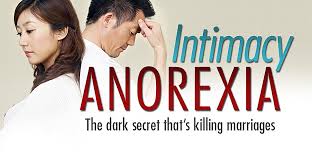
Intimacy Anorexia

It’s not my term. Author and speaker Dr. Doug Weiss coined the term and states it’s why some people “actively withhold emotional, spiritual, and sexual intimacy” from their partner. He writes that some of those issues can be identified as:

  • Keeping themselves busy with child care, household tasks, technology or work. Too busy for you, but not others.
  • Blaming you [or others] for the loss of intimacy rather than exploring potential patterns in their own behavior.
  • Withholding love, especially in the way you desire to receive it.
  • They stop complementing you.
  • Have little to no interest in sex.
  • Show little interest in connecting on a spiritual level.
  • Avoid talking about their feelings and not connecting on an emotional level.
  • Treat you more like a roommate and not a romantic partner.
  • Have money control issues or desire to control the money.
  • Have anger outbursts, ignore you or give you the silent treatment.

Wiess states it doesn’t take all these issues, maybe just five of them to experience sexual anorexia. He believes many persons who survive some form of sexual abuse will respond in this way to their marriage partners. 

Further, these relationships can be full of frequent criticism, including criticism of things one cannot change. 

Persons who exhibit these types of behaviors have more than likely experienced something traumatic in their growing up years. In their adult world, however, they are attempting to avoid the pain of their misguided view by avoiding intimacy. 

Intimacy requires trust in a relationship. It requires vulnerability. It requires safety and, of course, that all important ingredient: love.

Sexual intimacy within the boundary of marriage brings glory to God.

Sexual intimacy within the boundary of marriage draws marriages closer to God and one another.

Sexual intimacy within the boundary of marriage is always centered on your spouse.

Sexual intimacy within the boundary of marriage promotes deeper love, commitment and pleasure.

If you find yourself battling with any of the above descriptions of intimacy anorexia, please see a counselor who is familiar with the subject.  

Standard
Challenge, Encouragement, Healing, Marriage, Men, Postmarital, Women

Marriage Disappointment

Marriage is never 100% awesome and amazing. It’s hard sometimes and sometimes we say the wrong things. Sometimes we think the wrong things or do the wrong things. For everyone who is married, we are all on a learning path, a growing path. If your marriage has become critical or stale, it’s up to you to change that. If your marriage has become a disappointment in some form or fashion, perhaps you’ve veered from the path and have lost your way on the journey. 

The story is told that in his later years the legendary Babe Ruth had became overweight, slower, and struck out far more frequently. The baseball fans began to jeer him.

Apparently, the displeasure of the fans got to a small boy who leaped over the railing and ran onto the field to wrap his arms around the legs of this declining athlete. With tears plentiful in his eyes, the little boy expressed his love for the man that he knew he once was. The Babe picked the little boy up and embraced him as well. Together they walked hand in hand to the dugout. The crowd’s displeasure turned to cheers for the display of unconditional love on the field that day.

Your marital love is like that picture. Our marriage becomes “overweight” or “slower” and we “strike out” sometimes with our words and our actions or lack thereof. We fail each other occasionally. We make errors in the game of marriage and we disappoint one another. 

But regardless of how we may feel, every once in a while we need to wrap our arms around each other and express our undying love and remain faithfully on the journey of growing older together. 

                HAPPY VALENTINE’S DAY!

Standard
Challenge, Encouragement, Healing, Marriage, Men, Postmarital, Premarital, Women

Marriage Issues are “Our” Issues

Someone recently commented to my wife and I, “Wow, it encourages us to know that Steve and Mary had marriages issues too.” They were reading about our marriage in our book, Staying Together. We laughed as we confessed there is no perfect couple or perfect marriage.

In the book, we describe something traumatic that occurred to Mary, my wife. And in the book, we described how it affected our marriage for several years. 

An issue Mary was dealing with became a marriage issue because we are one. What affects Mary affects Steve; what affects Steve affects Mary. 

I could have gone on in life and lived in a manner that blamed her for the issue. I could have told her to get counseling for herself without me by her side. I could have distanced myself from the issues that were causing other issues and simply said, “It’s your problem; get it fixed.”

But is that the right approach in marriage? Is that showing marital commitment? Is that caring for another’s needs? Husbands and wives take this approach everyday saying, “It’s not my problem.” But if we’re married–if we’re one–then it is not his or her problem, it is our problem. When I make it my spouse’s problem, I am saying that I do not need to change, I do not need to support them and I do not need to be concerned. But, when I make it our problem, we are then walking and working together toward solutions and a better and a stronger outcome.

Marriage is a gift of oneness. There are three mentions of oneness in the scriptures: God the Father, Son and Spirit are one. Jesus and His church are one. A husband and a wife are one

As one, individual problems become our problems. So, get in there and fight for and alongside your spouse through each and every life issue. Find solutions together. Walk together and pray together. And to that end, find agreement together over any and all life issues.

Standard