 I have watched with interest over many years of my life the “women’s movement.” I am delighted that women can vote, wear pants in public and play an equal role in so many areas of our culture today. I am pleased to see women being urged to lead in many arenas. I love how God placed a part of His nature in women that all of us are in need of and benefit from. After all, without women, none of us would be here.
That said, I dislike how the movement portrays today that men are not important to women. I dislike that women are told, “It’s your body and you can do anything you desire with it.” We know this to be a reference to the killing of a child within their womb. (What about those pre-born women?) I dislike that one sex feels a need to rise above the other in order to feel valued or appreciated. After all, we are ‘opposite sex’ for many specific reasons. God undoubtedly planned it that way.
I find it hard to see some of the points being made today in a personal attempt to excuse rebellion against something. I openly wonder, “Who is lying to our culture in an effort to create these wars?” War doesn’t always bring about the changes desired. Certainly we each have needs that we are trying to meet, but to constantly and consistently battle one another seems unhealthy. Perhaps we have brought much of this on ourselves from our history, but today is so different from yesterday. I wish more people could appreciate where we have come to rather than continually fighting over where we once were and staying so stuck in the past.
For numerous personal reasons, I set out in my devotional time to catch the scriptures I found in a couple of the gospels in which Jesus connected to women and how He connected. It blessed me to see how He, in the middle of the Old Testament and the Law of Moses, embraced women, even within His ministry life. I love how He loves us and sees the value in each and every human being that He has created, regardless of race, religion or sex. In its simplest form, feminism is simply the act of advocating social, political and all other rights of women equal to men. I believe that Jesus operated that way and would never, ever desire women to be seen as less-than in any area of life, especially in relation to men.
Surely a huge part of this cultural war is the devaluing of women and men. I’ve never read words recorded from the mouth of our Lord while He was on the earth that helps to incite this cultural war, but rather, His words provide answers to those relationships. I love how He often had a piercing question to ask in return to a culturally sensitive question being asked of Him. For example, once the Pharisees’ were “testing” Him and asked, “Is it lawful for a man to divorce his wife for any and every reason?” His answer was, “Haven’t you read the scripture? (Question) And, didn’t you read that from the beginning God made them male and female; they would leave father and mother to be one? (Another question) Didn’t you realize they are no longer two persons, but one?” (My paraphrase)
In other words, Jesus, the Son of God, was valuing the woman in that she is equally one with her husband, not less than her husband. In the culture of the time in which these words were written, a man could legally divorce his wife for practically any cause. Jesus had every opportunity under the Law to say, “You’re correct; trash her; put her away never to be anyone’s wife again.” He didn’t. He was the Author of marriage, He wrote the book on marriage and then said, “Therefore what God has joined together, let man not separate.” Husbands and wives are a single unit. To love your wife is to love yourself and to love your husband is to love yourself; two have become one.
But the value of a woman started far earlier than this encounter that Jesus had. His Father chose to send Him, His Son, to earth. He did this by placing a seed from the Holy Spirit into a very young woman named Mary. Jesus could have come to earth with an army, with the angels or by simply dropping out of the clouds as a full-grown man. God chose a virgin to give birth to Him. The scripture records an angel speaking to Mary and telling her, “Mary, you have found favor with God.” (Matthew 1: 30) A woman found favor with the Creator. God looks favorably over every woman He has created.
On another occasion, one of the Pharisees invited Jesus to his home for a dinner. While Jesus was there reclining at the table, the Bible indicates that a woman who had lived a “sinful life” brought some perfume to wash Jesus’ feet and then actually cried tears over Him. She then wiped those tears with her hair. I can imagine this scene with all the men in the room aghast in unbelief and displeasure at the actions of this “sinful” woman. But instead of ridiculing her, Jesus used this act as a life lesson to those who were observing. Jesus sensed her heart, her repentance and moved toward her with words of forgiveness and justification. He actually said, “Therefore, I tell you, her many sins have been forgiven – for she loved much. But he who has been forgiven little loves little.” (Luke 7: 47)
Jesus had every right to send her away, back on the street to do what she did. The Son of God could have blinded her or sent her away crippled as her punishment, but He chose to receive her gift, her heart, and to forgive her – not a very popular thing to do.
 Did you know that not only did the disciples travel with Jesus, but that women traveled with Him as well? In the gospel of Luke, chapter 8 and verse 2, we are told that women traveled with Jesus and His disciples. What were they doing? Luke shares that these women were actually…”helping to support them [Jesus and His disciples] out of their own means.” (Luke 8: 3) Jesus had women with Him who were helping to pay for the needs of the ministry team. He valued their support and the important role they played with the team.
Later in this same chapter we have a little girl who needed healing and a woman who was bold enough to step up and touch Him. When she did, her faith was that she would be healed. Jesus knew someone touched Him desiring a miracle. She fell at His feet “trembling” in fear and their eyes met. She blurted out her story hoping someone would understand. She was instantly healed the scripture says and then Jesus said this, “Daughter, your faith has healed you. Go in peace.” The woman who was bleeding and unclean under the Law, was not only healed, but He called her “Daughter.” How honoring.
There were two special women in Jesus’ life: Mary and Martha. One day at their home, Jesus was sharing, as I presume He often did. Certainly customary for the day, the two sisters should have been busy preparing the meal and serving the men in any way they could. But it was Mary who just couldn’t pull herself away from sitting at His feet. Martha complained about her sister not helping and Jesus’ reply was keenly insightful, “Martha…you are worried and upset about many things, but only one thing is needed. Mary has chosen what is better, and it will not be taken from her.” (Luke 10: 41, 42)
Jesus not only affirmed these two women, but also longed for them to both sit at His feet together, receiving equally from Him. He loved them, spoke to them directly and said for them to not be taken away from the most important thing for men and women, sitting at His feet and learning of Him.
Jesus protected women’s sexuality and told us that it was wrong to look at woman lustfully. He was far harsher on adultery than the Old Testament was. He said that if you even look at a woman lustfully, you have already committed adultery. (Matthew 5: 29)
Jesus told us to honor our father and our mother, treating these roles equally. He said that if you curse father or mother, death was imminent.
Many women were at His crucifixion. (Matthew 27: 55) Why wouldn’t they be? This was the Man that treated them with dignity and the position within culture that they deserved. This was the Man they traveled with and who had forgiven them of their sin. This was the Man who loved them purely and without critical judgment.
My last scriptural expression of inclusion and equality is my favorite. The resurrected Christ could have first showed Himself to anyone He wanted to, any King, Priest or earthly authority. It was a couple of woman who first showed up at the grave. Two Mary’s arrived at the tomb early Sunday morning. Once again an angel comes to these women and declares during an earthquake, “Do not be afraid, for I know that you are looking for Jesus, who was crucified. He is not here; he is risen, just as he said.” (Matthew 28: 5, 6) It was the women in His life who were “looking” for Him.
In fear the women began to run off and suddenly Jesus was standing before them. They recognized Him and grabbed His feet and worshiped Him in jubilant praise while He spoke to them, “Don’t be afraid. Go and tell my brothers…” The Son of God declared His resurrection first to two of His female friends and commissioned them to tell the brothers, the men.
Jesus was an advocate of woman by treating them with purity, with respect, with honor, with protection, with equality and with dignity. It is a lesson for us as men to do the same. Any woman treated in this way by a father, brothers or a husband doesn’t need “equal rights” because she knows she is honored far above just an equal portion.
 I need women in my life. I need what they bring by being who they are. My daughter is in no way less than her brothers in our family. My wife is my partner and I am hers. Your female boss deserves every bit of respect that you would give a male boss. Paul said it so well when he wrote, “There is neither Jew nor Greek, slave nor free, male nor female, for you are all one in Christ Jesus.” (Galatians 3: 28)
Let’s be part of stopping the cultural slide of anger by being an advocate for all women just like our Lord was. Let’s be on a daily march of loving, respecting and honoring women. Let’s serve the women in our lives through the spirit of Christ who allowed “sinful” women to approach Him for forgiveness without judgment. Let’s tell the world of women in our circle that equal rights with men is not something they need to attain, because the Savior of the world has already pronounced their approval, their acceptance and all of their rights.
Women, all women, come find your place of freedom at His feet.

 I’ve never heard of a sanctuary city until recent news, but it made me think how we are desperately in need of such. In the Old Testament, the sanctuary was the inner court where atonement for sin would take place. The sanctuary was a place of God’s dwelling (“Then have them make a sanctuary for me, and I will dwell among them.” Ex. 25:8). According to Numbers 8:19 it was a place of safety from the plagues. In I Chronicles 28 God instructed Solomon to build Him a temple, a sanctuary. Importantly, while Israel was away from their homeland and scattered throughout different countries, the Lord said that He was a sanctuary to them. (Ez. 11:16)
 Some years ago I was meeting with a young married man for various counseling issues. I really cannot remember what they were, but I do remember one thing from that time. He inadvertently mentioned that he enjoyed “breaking and entering.” I said, “You what?” He shared that for years he and his friends would break into garages and sheds and steal small items simply for, “The thrill of it.” I shared, “You do know that stealing is against the law, not to mention one of the Ten Commandments, right?” He assured me that he did, but added that no one has been hurt by his actions and that he enjoyed the dare and the challenge. “Further,” he said, “I find nothing wrong with it.” I added, “But I thought you told me you were a Christian.” He assured me he was.
 A counseling plan: During his history statement he shared that he and his wife had a young son who was five years old. I had a plan. I looked straight at him and with boldness said, “I recommend you take your five year-old son along with you and the gang the next time you decide to break into a place.” He said, “What?” “Yea,” I continued, “Take your son, he’s small and you can put him through a window and then he can unlock the door for you to enter.” With a wrinkled face he replied, “I thought you said you were a Christian counselor.” “I am,” I told him. “But here’s the thing…start your son out young and train him thoroughly in thievery so he can be just like his dad.” I went on to say, “In commonality the two of you can have some real father/son bonding time breaking into sheds and garages.” I went on to say, “You’ll be so proud when he becomes just like you!”
 Running out of ideas for inexpensive, but fun date nights? It’s time to celebrate your Valentine, so here are a few ideas, many that my wife and I have enjoyed over the years:


 You most likely know about the railings of the Pont des Arts pedestrian bridge in Paris, France. For years couples have been placing pad locks on this railing and then throwing the key into the River Seine as a romantic ritual of their love. Eventually the city had to intervene. It seems that according to those who know such things that the added weight of thousands of locks affected the integrity of the bridge and needed to be removed.
 one another and “locked” together in love. In 1975 I said “I do” to my bride, Mary, while at the same time saying “I don’t” to every other woman. We never put a padlock on the bridge in Paris, but we have remained committed in our love to God and then to each other. I guess when God’s word says that His love endures forever (Ps 106:1), He provided a picture to us that love can, at the least, endure a life-time.
 redemptive process from the inside out. To know God and to know His love is to live within this ongoing process. To not know Him is to live outside this process.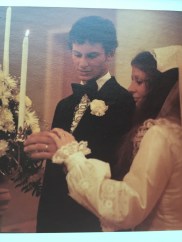

 It’s pretty rare to attend a wedding today where the bride and groom are under age 25. More often, it’s a couple who are approaching their mid 30’s. The reasons? There’s college and then there’s college debt. Then a career to help pay that debt and perhaps even graduate school – more debt. The pervasive attitude becomes waiting until all the stars align, i.e., school, jobs, housing, money, etc.
 Grandparents can pass on or become too old to relate in healthy and fun ways with their grandchildren. And when that happens, something very, very important and essential is lost in our culture.
 My assignment was clear: completely renovate our outdated bathroom during my Christmas vacation. Its décor was left over from the 1990’s. The flooring had yellowed. The walls needed fresh paint. Nails had popped through the drywall and in general it was looking old and tired. It was time to, “Forget the former….” (Isaiah 43:18) The materials were purchased and the work began. The floor would be covered with a new material, the walls would receive a wainscoting and the paint would be an updated color. “See, I am doing a new thing!” (Isaiah 43:19) The change was incredible and when finished my wife exclaimed, “It’s a complete transformation!”
 Weariness. This morning Mary and I prayed together about “a spirit of weariness.” We felt it at different times throughout the year of 2016. There were multiple illnesses we were battling. There were major concerns in our family with aging parents. There were emotional and spiritual attacks that seemed to come out of nowhere. Of course the elections were within themselves a whole new level of campaign weariness and continually planting seeds that did not appear to take root. It’s a bit hard to describe or put our finger on any one thing, but all together they spelled: W E A R I N E S S.
 Press on. 2017 is a whole new opportunity. No matter what is at the root of your weariness, do not give up!
